


BEIJING, China – Earlier this month, China’s National People’s Congress voted to extend a national anthem law to the autonomous territory of Hong Kong, another reminder to the people of the island that Beijing aims to fully incorporate the city into the mainland legal system.
The anthem law was enacted in mainland China in September. It states that “anyone who plays or sings the anthem in a distorted or disrespectful way” can be jailed for 15 days. On November 4, the NPC inserted the law into Hong Kong’s mini-constitution and endorsed a change to China’s criminal code to make the violation of the anthem law punishable by up to three years in prison.
As a special administrative region of China Hong Kong has its own legal system, so the new law has to pass the Hong Kong’s legislature in order to be enacted in the city.
It is not clear whether the punishment for mocking the anthem in Hong Kong will be as severe as in the mainland, but the law itself is expected to pass the legislature without problems. Beijing-backed Hong Kong Chief Executive Carrie Lam said on November 7 that she hoped the city’s Legislative Council will “fulfil its constitutional responsibility” in discussing the matter and approving the bill “efficiently.”
“This extension is aimed at strongly and symbolically reminding HK people that they are Chinese and a part of the PRC. The law will be applied to HK residents, but the penalty for infringing the law will probably be lighter,” Jean-Pierre Cabestan, head of the Department of Government and International Relations at Hong Kong Baptist University, told The Globe Post.
It is not clear how the law will be implemented. Ms. Lam said, “the law would only forbid the deliberate insulting of the playing and singing of the anthem. I can’t see how this could be related to the city’s freedoms in any way. It would be unnecessary to worry about falling into legal [traps] unintentionally.”
Most likely the law will first and foremost be applied to the Hong Kong’s football fans who frequently boo the Chinese anthem during football matches. On November 9, football fans in Hong Kong defied the new law by jeering the national anthem during a friendly match with Bahrain.
Mr. Cabestan said the law’s “implementation will remain a problem, anyway: Whether the HK authorities be able to stop and prevent future ‘boos’ at football matches remains an open question. I personally think that it will be hard to implement, but they will try, creating more frictions between the activists mobilized by Beijing and Hong Kong youth in general and localists in particular.”
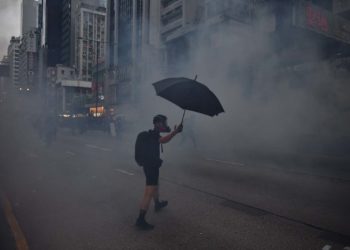
Localists are political activists who call for the greater autonomy for Hong Kong, and even independence from China. They became especially active after the so-called Umbrella Movement, a series of pro-democracy protests that took place in Hong Kong in the fall of 2014.
Localist activists participated in 2016 legislative elections in Hong Kong and managed to win six out of 35 seats allocated for geographical constituencies but were all later disqualified over the a controversy surrounding their oaths of office. Their oaths during the inaugural meeting were found invalid as some of them changed the words pledging to “guard over the interests of the Hong Kong nation,” while others added anti-Beijing statements before or after the oath. One of the legislators took such long pauses between the words in the oath that it lost its meaning.
Among the disqualified legislators was Nathan Law who, along with Joshua Wong and Alex Chow, was among the most prominent activists of the Umbrella Movement.
On August 17, Mr. Wong and Mr. Law were sentenced to prison for six to eight months for unlawful assembly and Mr. Chow was given the same sentence for incitement to assemble unlawfully in connection with a protest at Civic Square in Hong Kong in September 2014. They were convicted last year and given community service orders or, in the case of Mr. Chow, a suspended sentence that would allow him to continue his studies at the London School of Economics. The government appealed their sentences and in August the Court of Appeal sentenced the three men to prison.
Steve Tsang, director of the China Institute at the School of Oriental and Asian Studies, believes the imprisonment of the three activists is among the most important measures Beijing has taken with regard to Hong Kong since 2014. “The re-opening of the cases against the young politicians for their conduct in the 2014 protests marks a change in how Beijing and the SAR Government choose to deal with dissent,” he told The Globe Post.
The decision of the Court of Appeal bars Mr. Wong, Mr. Law and Mr. Chow from running for public office in the next five years. Mr. Law was an elected legislator prior to his disqualification and Mr. Wong has expressed a desire to run for public office in the future, although he could not participate in the 2016 elections due to his age – he was only 19 years old at the time.
The activists won’t give up easily. Mr. Wong and Mr. Law are now appealing their sentences after they were granted bail on October 24 by Hong Kong’s Court of Final Appeal. Mr. Chow did not apply for bail and continues to serve his 7-month sentence.
The imprisonment of the three activists prompted protests, and their supporters have called them political prisoners. Regardless of what awaits Mr. Wong and Mr. Law, in the future the standoff between Beijing and Hong Kong’s politically active youth will continue.
Mr. Cabestan said, “Young Hong Kongese are more sensitive to liberty, political rights and democracy: they want full democracy to Hong Kong as it was promised in the Sino-British declaration and the basic law.”
What makes this young generation of Hong Kongers different from their parents is that they are not afraid of Beijing.
“Those who saw what happened in Beijing in June 1989 know what the PRC Government would do to dissidents and protesters. The younger generations in Hong Kong only knows of the events via books or video clips, but never shared the sense of horror as the events unfolded. The younger ones do not know what they are dealing with in the Chinese Government. Hence they are not afraid,” Mr. Tsang said.
According to both Mr. Tsang and Mr. Cabestan, it is unlikely that Beijing will launch a Tiananmen-style crackdown in Hong Kong. However, the Chinese government will continue to put pressure on the city in order to bring it closer to the mainland and gradually get rid of the “one country two systems” policy.
Whether Hong Kong manages to protect its autonomy will largely depend on political developments inside mainland China. As the events in Hong Kong in recent years demonstrate, no matter how hard young pro-democracy activists try to fight, Beijing still prevails. Unless major changes take place in China before 2047 when the Sino-British agreement regulating the Chinese rule over Hong Kong expires, Hong Kong will most likely be “absorbed” by mainland and lose its autonomy.