

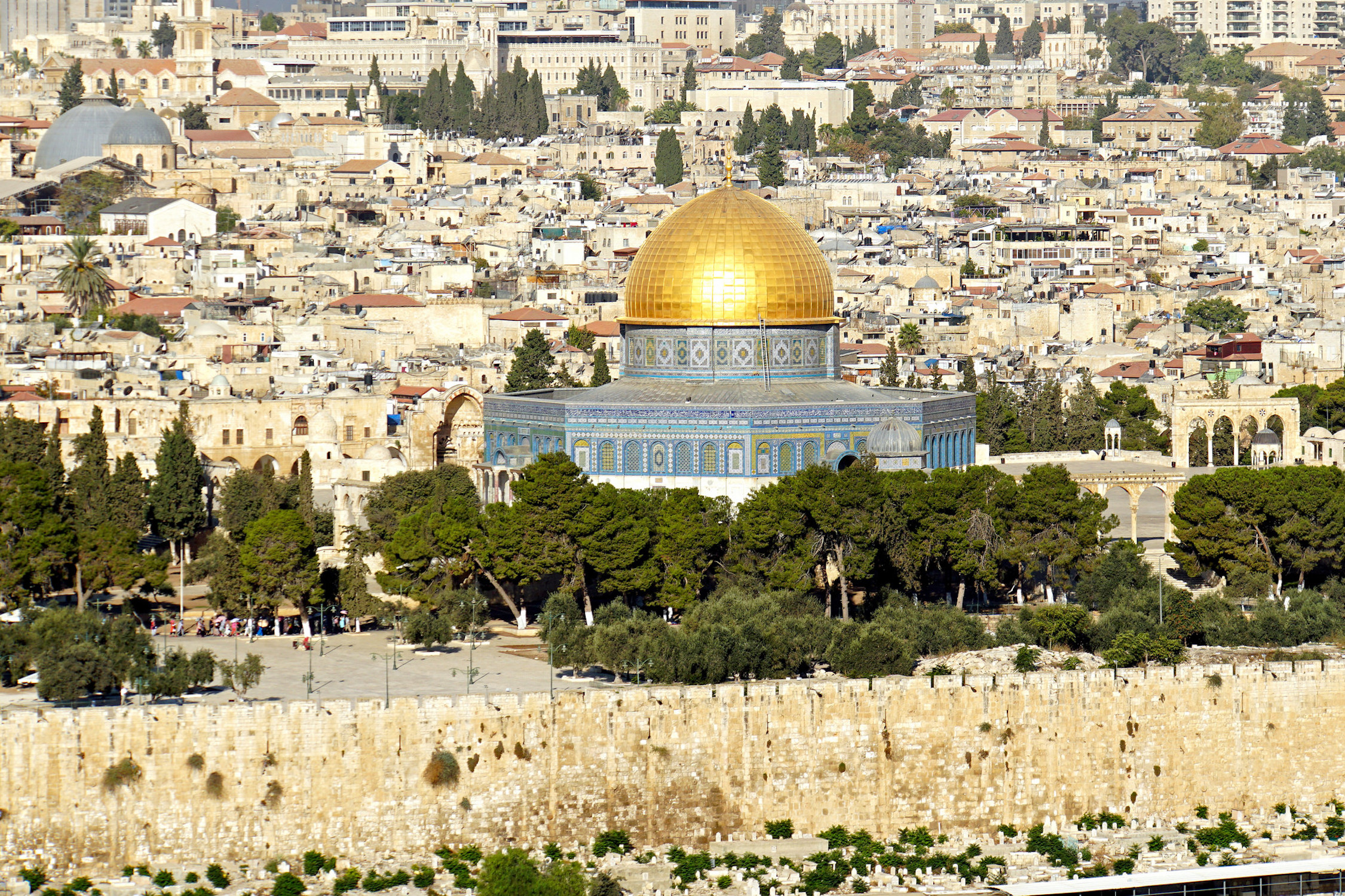
On 5 December 2017 senior U.S. administration officials confirmed that the U.S. will be effectively recognizing Jerusalem as the capital of Israel by moving its embassy from Tel Aviv to the contested city. President Donald J. Trump had expressed his intention to do so during his electoral campaign and reiterated it after his oath of office.
His decision was a departure from a tradition established by Presidents Clinton, Bush, and Obama, who refused to implement the Jerusalem Embassy Act of 1995, adopted by the U.S. Congress on 23 October 1995. The Act called and allocated funding for the relocation of the U.S. mission in Israel and recognizing Jerusalem as the undivided capital of the country.
Whereas just like his predecessors, Mr. Trump signed a waiver postponing the implementation of the Act, he broke ranks with them by rejecting their rationale. Clinton, Bush, and Obama’s objection was premised on considering the Act as an infringement on the President’s constitutional authority over foreign policy, while the current president signaled that U.S. foreign policy on the issue of Jerusalem is aligned with the decision of the Congress.
The announcement breaks with years of precedent premised on a cross-party consensus in the U.S. that any act that recognized the annexation of East Jerusalem by Israel and its designation as its capital would affect the fragile balance of power in the Middle East and the ability of the U.S. to promote its interests in the region and globally.
As we have previously argued, the move is extremely significant as Jerusalem is not just a city of historical importance to Judaism, Islam and Christianity, but also a site of contestation and affirmation of identity and belonging for Israelis and Palestinians alike. If one adds to this the political weight of the status of Jerusalem in the Israeli-Palestinian conflict, often described as one of the world’s most intractable disputes, it is clear why the decision to move the U.S. embassy there is highly problematic.
It ignores the fact that most Israelis and Palestinians see Jerusalem as the capital of their states, present and future. As the final status of Jerusalem was deemed to be one of the thorniest issues in the Oslo process it was envisaged to be circum-negotiated and dealt with at the stage of ‘Permanent status negotiations’, once all other issues between the state of Israel and the Palestinians would have been resolved.
The move of the U.S. embassy can be construed, despite Mr. Trump’s reassurances to the contrary, as a rejection of the commitment of U.S. policy to the two-state solution brokered and endorsed in the Oslo agreement. Despite its failure, Oslo process has been considered to be still demarcating the route to a mutually acceptable solution among Israelis and Palestinians supporting the establishment of two neighboring states.
In Israel itself, the decision will embolden those who advocate a more aggressive territorial policy and the continuation of the erosion of the possibility of an independent Palestinian state as it will be seen as a vindication of their uncompromising stance. Its symbolic value among nationalist circles in Israel, but also among many ordinary Israelis, is not to be underestimated. The coalition government, as well as its predecessors, have been active in strengthening Israeli claims to the entire city since its annexation back in 1980.
Sprawling Jewish settlements around Jerusalem has aimed to ring-fence the city and integrate it more into Israel. Building restrictions in East Jerusalem, and a series of recently lifted restrictions to Palestinian access to the Al-Aqsa mosque, built on the remnants of the last Jewish Temple, had further turned the issue of the status of the city into a highly contentious one.
As there has not been any progress in less important, yet substantive issues, the issue of Jerusalem acquired even more of a symbolic importance among Palestinians. Jerusalem constitutes a central terrain of Palestinian self-imagination as other, more material, anchors of identity such as territory, governance and self-determination are continually eroded by the harsh realities of Israeli occupation, the Gaza blockade and the ever deteriorating cooperation between Israeli and Palestinian authorities. The calls for a new intifada that have been made over the past few days contain a considerable dose of wishful thinking within Palestinian, Arab and Muslim movements that have, over time, invested in the Palestinian cause, yet one cannot underestimate the impact of the Trump administration announcement in the region.
The Palestinian Authority leadership, marred by corruption and having more or less settled with the status quo, will be further challenged by existing opponents, such as Hamas, but, more importantly, with potentially new actors supporting more militant responses and drawing on the resentment over the decision. The demoralized, ever-fragmenting Palestinian society will most likely translate this new symbolic blow to any hope of establishing a two-state solution in several ways.
It will orient itself to one-state solution that would require a radical transformation of the whole historical Palestine: from a multiethnic state where Jews and Arabs alike will enjoy equality and civil rights guarantees, to a more utopian-looking Arab state cleansed of its Jewish population. Parts of Palestinian society might find solace in anomic, atomized methods of ‘resistance’ akin to the epidemic of knife attacks of 2015-2016.
Regime insecurity, central in the politics of several of the monarchies of the Arab world that have had, on various occasions, to pay at least lip service to the Palestinian cause, including the recent very Saudi ‘coup’ is likely to be accentuated. Mr. Trump’s decision might prove to be a constraining factor in their policy choices. But the most important threat to them will come from internal opposition by Islamist and nationalist challengers who will use the continuing stalemate and the Jerusalem decision as proof that the Arab regimes are not able to defend the interests of the underdogs in the Middle East.
The announcement is likely to aggravate the tense relationship between Israel and Iran, especially if one adds to the equation U.S. support to Saudi Arabia’s policy towards the Islamic republic and the White House decision to decertify the Iran nuclear deal.
Finally, there are indications that by pushing such a symbolically and politically issue to the foreground, the U.S. may be setting in motion a series of foreign policy realignments in the Middle East. As U.S. policy towards Iran, Iraq and Syria has opened up spaces for Russia to entrench its presence and influence in the region, Jerusalem might provide the crucial legitimacy for Russia to become more active.
Mr. Trump’s move, and more generally, his revitalization of the U.S. alliance with Israel, may further strengthen Russia’s rapprochement with Hamas, especially as relations between Russia and Israel are at an all-time low, due to their diverging Syrian strategies. Although Russia may not have a clear ends-driven regional strategy, it has visibly sought to improve its short-term economic, military, and political advantages. Moscow is also reducing the short-term advantages of the U.S. in the region by turning its largely transactional relationships into more durable ones.
Russia’s concerted effort to reclaim its role as the arms supplier of choice for Arab governments, and a decision to retain a presence in Syria is likely to be eventually transformed into longer-term economic, energy as well as arms-related relationships.
The Jerusalem issue has the potential of further reducing whatever credibility the U.S. had as a broker/actor in the Middle East and leaving the space for Russia to become more active and influential. But only time will tell.
Disclaimer: The views and opinions expressed here are those of the author and do not necessarily reflect the editorial position of The Globe Post.