

Did the EU make a mistake by announcing a long-awaited new strategy for the Balkans that re-confirms a credible enlargement perspective for a group of Western Balkans states, and first of all, Montenegro and Serbia?
The EU has never been seen as an actor willing to take a risk and make bold moves. Weakened by the recent migrant and financial crisis, Brussels’ decision to continue with further accession and even setting a tentative (target) date – 2025 – as a possible new wave of enlargement, doesn’t look as a move in the right direction at the first glance.
What prompted Brussels to reinvigorate the EU perspective of the region hampered with outstanding bilateral issues and challenges such as corruption and the rule of law? Why is this region so important for the EU to make, for many, a surprising move towards further expansion in the midst of Brexit talks?
While politicians in the Balkans applauded the EU strategy that keeps their European perspective alive, the one thing is clear: the new policy doesn’t reflect a Copernican turn of mind for Berlin, Paris or The Hague. Although a post-Brexit Europe is getting more favorable for EU citizens, they are still not supportive of the idea of further enlargement and want to keep control over EU membership, trade and migration.
The answer for this question lies in the growing influence of Russia and China in Eastern Europe and the Balkans, that have over time established themselves as an alternative to what seems to be a long-shot EU perspective promised by Brussels 15 years ago. The EU should do something palpable in order to reverse trends in its backyard.
Burdened by its own problems, the EU has neglected the European Southeast corner, giving an opportunity to other global actors to make strategic gains in the region. The EU foreign policy chief Federica Mogherini had a reason to be concerned when she described the Balkans as a new “chessboard where the big power game can be played.”
Indeed, Moscow’s meddling in Southeast Europe is well known. Empowered by a long tradition of strong cultural and political ties with countries from the region and energy-driven deals, Moscow has become an indivisible player in the Balkans’ affairs. For example, Russian crude oil import accounts for 84 percent of the total consumption in Bulgaria, the current presidency of the EU, and 70 percent of Serbia, the biggest state in the Western Balkans.
The coup attempt in Montenegro in 2016 and the recent shipment of 2,500 automatic rifles to Bosnian Serbs police prove that the Russian posture in the Balkans is gradually shifting from soft to hard power. Russian military advisers will supposedly be engaged in a training program of the Serbian police in Bosnia and Herzegovina, as they trained the notorious Serbian paramilitary group Serbian Honour.
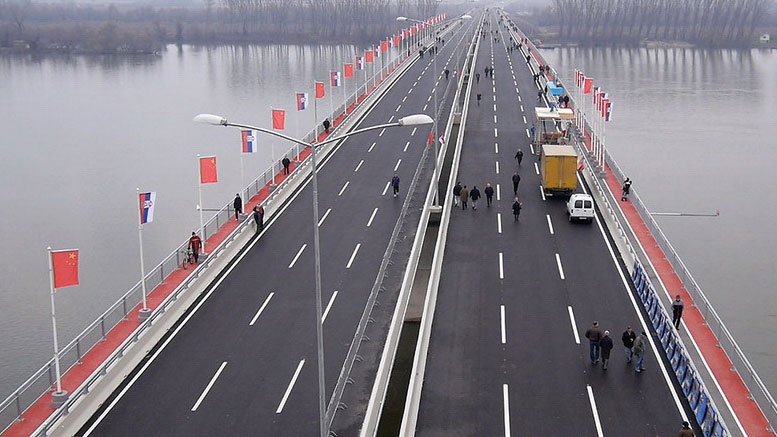
Beijing’s “One Belt One Road” policy seems to be even more challenging for Brussels. It is already affecting the Balkans, and its presence is visible in almost every corner of the region. China’s springboard to Europe, 16+1 framework, is made up of eleven EU members and five EU aspirant countries from Central and Eastern Europe (CEE). Created on April 2012, the framework constitutes a platform for cooperation between China and the CEE. With its 120 million citizens, CEE & Balkans are a desirable partner and market for Chinese products and Foreign Direct Investment (FDI).
The trade between the region and China has been increasing for years, reaching a total of $56.2 billion. Two years ago, China launched a 10-billion-euro investment fund to finance projects in this part of Europe, fueling concerns that the EU would be gradually outplayed by China’s rising economic influence. Most of the billion dollars’ worth Chinese investment in the Balkans are centered on transportation infrastructure, the energy sector, and heavy industries. The critical role in this strategy is reserved for Greek port of Piraeus which is now in the hands of a Chinese logistics giant COSCO.
Unlike Moscow, a spoiler actor that is trying to exploit existing regional problems to drive a wedge between politicians in Brussels and local leaders, China economically benefits from the region’s stability guaranteed by the EU.
While the EU asks for a long, demanding and politically hurtful process of democratic reforms – that will eventually, however, lead to the creation of economically viable and politically accountable democratic systems – China (as well as Moscow) are not interested in the democratic transformation of those states.
Giving a preference to a state-led, leader-to-leader type of deals that take no account of whether projects are market-driven, transparent or in accordance with strict EU regulations, Beijing gradually thwarts Western demands for painful democratic reforms.
Given the democratic challenges on the Balkan side and the need for hot money in order to revive their uncompetitive economies, states in the region have put themselves in a position of dependency on Beijing. Chinese loans, granted under soft and permissible conditions, have led to an increase in the region’s debt burden. Five Balkans states alone –- Albania, Bosnia and Herzegovina, Macedonia, Montenegro, and Serbia — have in the recent past borrowed nearly $6.6 billion from Chinese banks.
The experience of other regions, including Africa, where China has established itself as a strong player suggests that, behind China’s alleged generosity, lies a clear interest to project Chinese economic influence and political interests.
It is clear why the EU is getting nervous when it comes to Moscow’s and Beijing’s inroads in its backyard. Complicated and bureaucratized procedures on the EU side, an uncertain EU perspective, and the reform fatigue on the Balkan side coupled with a fueled-by-Moscow rampant discontent with the model of liberal democracy facilitate advances of EU’s global rivals like Russia, China or, even Turkey.
The EU cannot compromise its reform agenda, but if Brussels is to win, the EU must play a proactive role and offer a new, vivid and attainable opportunity. The plan, backed by major EU states, released in February can be a turning point for the future of the region.
Not only is the EU key political partner of this part of Europe, but it is also the most important investor in the region with the annual total trade volume of 43 billion euros. The plan envisages that in 2018 alone, 1.07 billion euros of pre-accession assistance for the region will be made available. In parallel to the rule of law, security and migration, for the first time, the priority is given to transportation infrastructure and energy connectivity projects, the areas where Russia and China have been making advances.
Under given circumstances, the EU doesn’t have any better option but to resort to its own soft power and reconfirm the EU membership perspective for the Western Balkans.