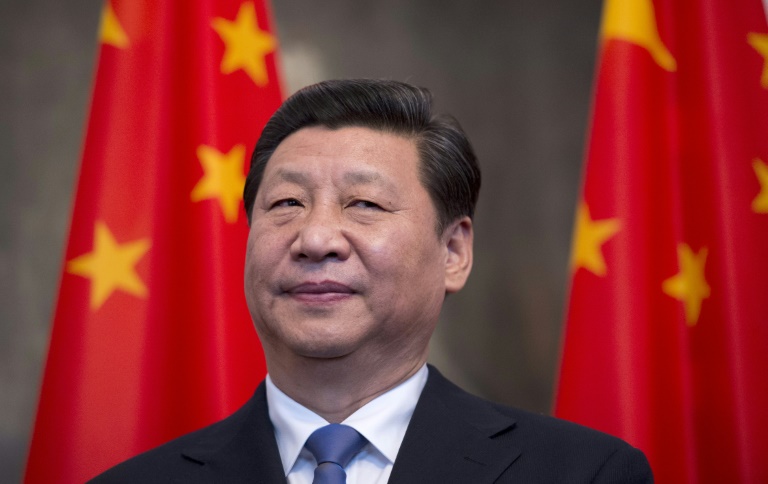


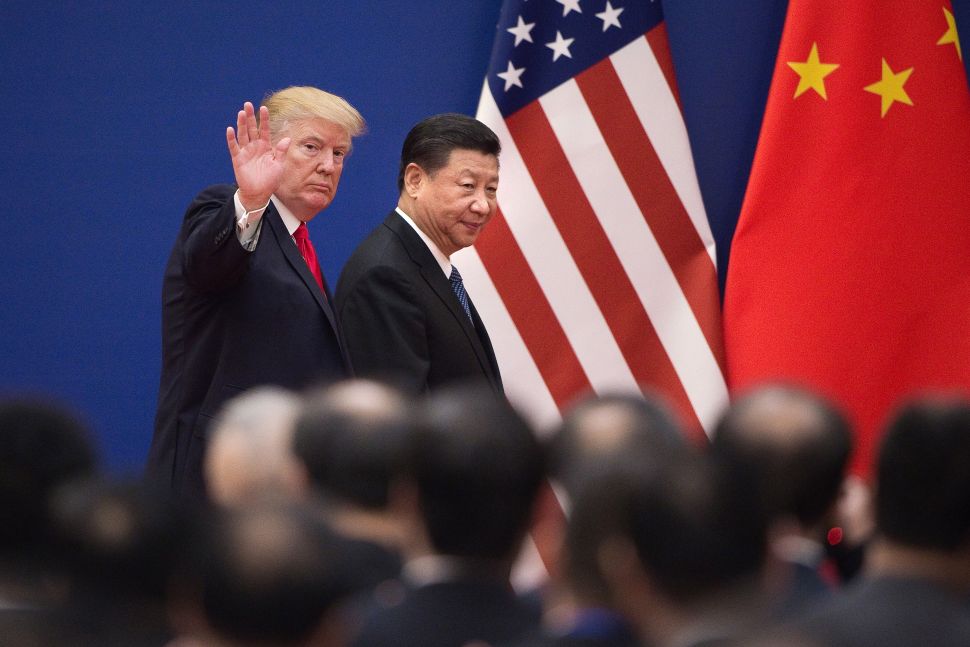
President Xi Jinping sought to reassure Chinese entrepreneurs at a meeting Thursday with promises to prop up private firms with lower taxes and more funding, as he acknowledged uncertainty in China’s economy.
Xi held the meeting amid signs that the world’s second-largest economy is losing steam as it faces a trade war with the United States, a massive debt buildup and a weakening currency.
Though China’s overall economic status is stable, “uncertainty in our country’s economic development has clearly increased, downward pressure has grown, and companies are facing more difficulties,” said Xi, according to the official Xinhua news agency.
Xi, who has voiced his support for private firms multiple times this year, made several policy suggestions, including lowering corporate taxes and resolving funding challenges faced by companies.
He also proposed that provincial governments raise their own “rescue funds” to bail out companies.
Xi also emphasized creating a fair and competitive business environment and tasked local governments with “correcting” the behavior of certain government departments, as well as large companies that use their dominance to “bully” smaller firms.
Xi Jinping said the country will unswervingly encourage, support and guide the development of the non-public sector and support private enterprises to develop towards a broader stage.
— China Daily (@ChinaDaily) November 1, 2018
Sapping Confidence
U.S. tariffs on half of what China exports to the United States have sapped confidence in Beijing’s ability to maintain current growth levels.
Analysts say that the country’s overleveraged companies and local governments are likely to put a further drag on expansion.
It was the second meeting this week in which Chinese leaders vowed to protect the economy.
Xi presided over a conclave of the Politburo on Wednesday, with the leadership saying China had “achieved overall economic stability with steady progress” in the first three quarters but more work needed to be done to help the private sector.
A key indicator on Wednesday showed that Chinese factory activity slowed in October, the latest sign that the economy is losing momentum.
The Purchasing Managers’ Index (PMI) came in at 50.2 for the month, down from 50.8 in September, the National Bureau of Statistics said.
A separate survey calculated independently by the Caixin media group showed factory activity at 50.1 in October, up from 50 a month earlier, which had been its lowest level for 16 months.
A number under 50 indicates a contraction.
Further complicating the picture is the falling price of the yuan against the dollar, with the unit at its lowest level in a decade.
A weaker yuan makes Chinese exports less expensive overseas, offsetting some of the higher costs brought by the U.S. tariffs. But it has also driven up the cost of importing critical raw materials from abroad and threatened domestic confidence in the currency, driving some investors to move assets overseas.
As the trade war rages on, China is also trying to build business alliances with other countries and entice more foreign enterprises into its markets.
Next week, China will host an enormous import fair in Shanghai featuring thousands of international companies, including General Motors, Ford, Microsoft, and Foxconn.
Xi has called it “no ordinary exhibition” and a sign of China “actively opening up markets.”
But the playing field is far from level for international firms in China, critics say.
In an annual report released by the European Chamber of Commerce in September, foreign companies listed a myriad of woes, including preferential treatment for monopolistic state-owned companies, market access barriers, and government red tape, as well as intellectual property protection and forced technology transfer.
“China’s old economic order is still lingering in society,” said Mats Harborn, president of the E.U. Chamber, noting that the Communist Party’s determination to make state-owned enterprises “stronger bigger and better” was actually detrimental to the development of China’s economy.
Trump’s New China Tariffs Could Slow Growth of US Economy, IMF Warns