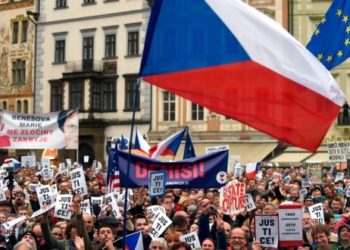


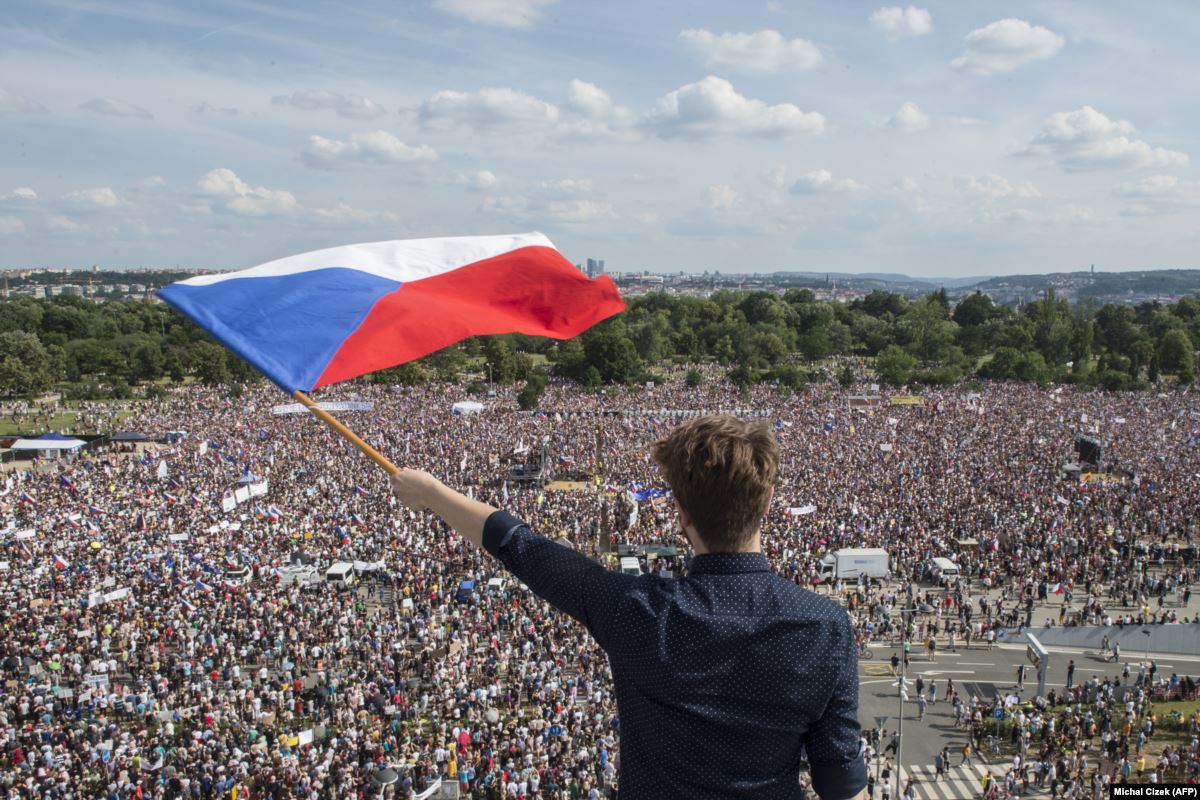
The Czech economy is going great guns, and the capital Prague – with its ancient palaces, churches, and golden spires – attracts armies of tourists who come to spend happily and with abandon. The country has enjoyed a degree of prosperity that is without precedent. Yet, its public squares are full of angry protesters reminiscent of the famous Velvet Revolution of 1989 that brought down the old regime and freed the country after 40 years of Moscow-imposed communism.
Why do successful citizens protest in the middle of their lucky streak? It is a paradox that deserves explaining. But first some background.
The Poles resisted communism from the moment the Red Army entered their country at the end of the war. In 1980, they formed Solidarity, an independent trade union that helped delegitimize Soviet rule over Eastern Europe and brought about its dissolution 30 years ago. It was in Poland that communism was defeated, and it was the Poles who gave the impetus for the collapse of the Soviet bloc.
The Hungarians caught the world’s attention with their self-sacrificial struggle against the Russian tanks in 1956. After the inevitable defeat and several years of terror, they proceeded to dismantle the alien Soviet system. It happened slowly and with such stealth that they had avoided Moscow’s wrath. Consequently, the country had become virtually free even before the Berlin Wall came down at the end of 1989.
And then there were the Czechs. The Stalinist regime conquered the country relatively late – in February 1948. It was brutal and it encountered little resistance. In August 1968, Moscow suppressed the Prague Spring, a short-lived attempt at reforming the communist doctrine. Within less than two years, the country was returned back to the status of a sullen but compliant Soviet satellite. There was eventually some resistance (Charter 77) and brave people who organized it (the playwright Vaclav Havel). But the Polish Solidarity was said to have close to 10 million members, while Charter 77 – if we count those who had joined when it took courage – about a thousand.
Czech Republic’s Velvet Revolution
The miraculous Velvet Revolution in November 1989 in Prague brought freedom. This was celebrated, and properly, too. Vaclav Havel’s incredible journey from a communist prison cell to the Presidential Palace was hailed as a modern-day fairytale.
But when Havel left politics, there was no one to replace him, and no civil society that could be mobilized to defend the young democracy against the growing corruption among grabby politicians and a tendency toward anti-European Union positions, the latter – just conceivably – taking place with subtle support from Vladimir Putin.
No one has proven that the anti-liberal, anti-Muslim, anti-migrant, anti-gay, and anti-environmentalist policies of the Prague politicians exist because they are supported by Russia. But all pronouncements by government officials along such anti-E.U. lines receive enthusiastic approbation from the present team in the Kremlin and its global media that practice disinformation and sow discord.
Swing Toward Russia
Vaclav Klaus and Milos Zeman, Havel’s two successors in the presidential office, entered public life in the early 90s as advocates of democracy, free market, and liberal values. This started changing with the arrival of the new century. Putin’s conquest of Crimea and the military intervention in eastern Ukraine caused Klaus and Zeman to change their ideologies completely.
They used to hail the West as a source of inspiration. They now denounce it as a threat to “traditional values.” They speak scathingly about migrants escaping from war and behave as if a nation were an ethnic tribe that had to exclude all others to survive. They denounce the West as seeking to poison the Czech minds with “genderism,” “feminism,” “political correctness,” and even something called “human-rightism.” They have argued that the “dictatorial E.U.” and its liberal policies represent a more pernicious evil than the Kremlin under Leonid Brezhnev.
Klaus believes that the Czech Republic would prosper if it found the courage to leave the European Union. Zeman holds the same view but is more cautious. As he never tires noting, the Czech Republic annually sends €1.282 billion to Brussels but receives back €3.875 billion. That is the reason why it should stay – for the moment, that is. Despite some cosmetic differences between them, Klaus and Zeman have together pushed the Czech Republic toward the magnetic field of Putin’s Russia.
Arrival of Andrej Babis
But neither Klaus (born 1941) nor Zeman (born 1944) will be able to dictate the course of Czech politics for long: even today many see them as vacuous and tired men who ran out of ideas eons ago. The current crisis has been triggered by a personality that used to be hidden behind the Klaus-Zeman tandem but has now come to dominate Czech politics.
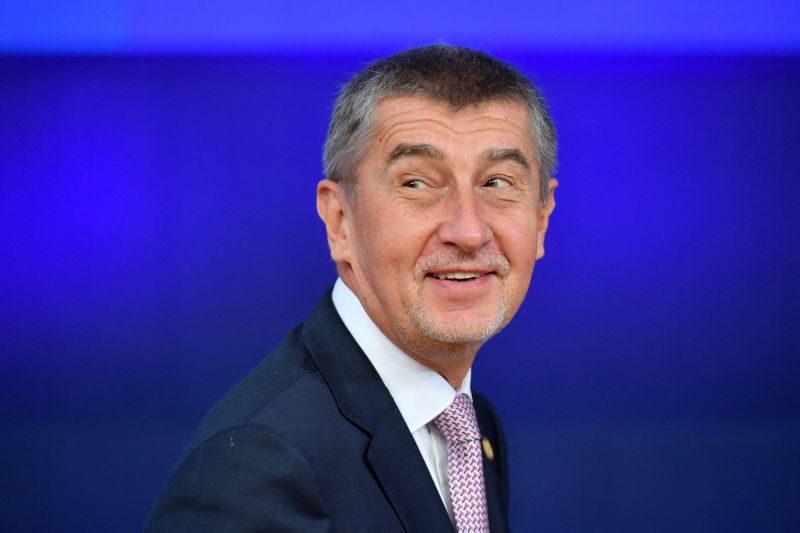
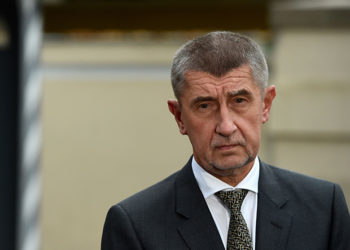
Andrej Babis (born 1954) grew up in a family of privilege: his father, a high-ranking communist, made it possible for the young man to be educated in Geneva, among other places. According to archival documents, in 1982 young Babis agreed to work for the communist intelligence service and then acted as a commercial representative of his country in Morocco from 1985 to 1990.
Babis’ knowledge of the world outside the communist realm served him well once the old regime’s power structure melted away in the early 90s. His business interests covered a wide scale of activities, mostly in the Czech Republic. Agrofert, a company he established in 1993, grew rapidly into a multi-national enterprise that now, according to its website, employs 33,000 workers in 18 countries. Babis’ personal wealth is estimated to be around $3.7 billion, which places him on a par with his idol President Donald J. Trump.
But there have been critics, and some are quite noisy. They have argued that various financial stratagems practiced by Agrofert are outside the legal framework. This led Babis to discover that in the former Soviet bloc it is easier to make money than to keep it. In short, it was time for him to enter politics.
How Babis Solidified Power
His first move was to buy the two most popular and influential newspapers in the country, plus radio and television stations.
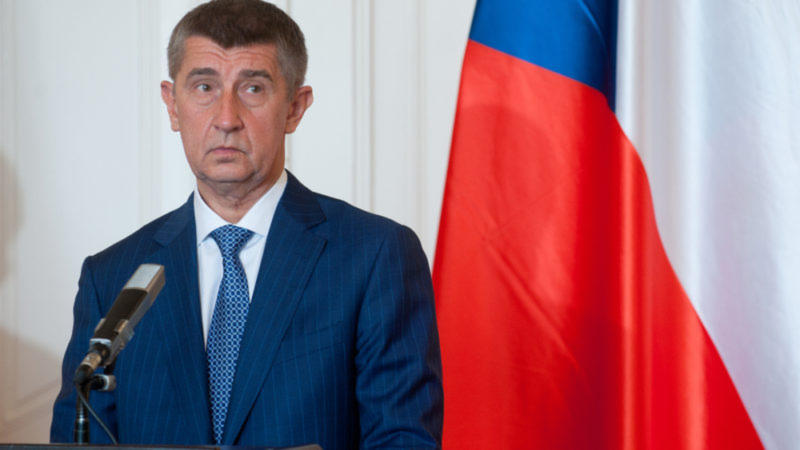
Then, in 2011, he established his political party, ANO. He presented himself as a political outsider who knew how to run large organizations. His main mission, he said, was to eradicate corruption. The voters believed him when he noted with a smirk that being so rich made it unlikely that he would misuse his political office for personal gain. His in-your-face political campaigns have been successful. In quick succession, Babis has served as a deputy in the parliament, minister of finance, and now prime minister.
Wow. Drone footage of Protests today in #Prague Demanding Resignation of PM Babis over fraud.
Biggest rally in Czech Rep. since communist era. HT @GEsfandiari pic.twitter.com/IQ7Kf4yXLR
— Joyce Karam (@Joyce_Karam) June 23, 2019
Evidence regarding his service as a communist spy in the 1980s is bothersome: it is illegal for persons with such backgrounds to hold a political office in the Czech Republic. But an army of lawyers and lots of obfuscation have helped him to hide the matter under the carpet, for the time being.
Stork Nest Affair
But there was one affair that could not be removed from public scrutiny. It transpired that Babis built a resort called the Stork’s Nest with the help of funds intended to assist small entrepreneurs. Since the size of his portfolio would have disqualified him as an applicant, he formally transferred title to this property to someone else who qualified as a small entrepreneur. All along, Babis spoke about the Stork’s Nest as his property, while for the purposes of attracting public money, it was registered as belonging to somebody else.
Many believe that this form of fraudulent behavior is intolerable in a political figure. The police began investigating the case in 2015 and, two years later, the parliament deprived Babis of his immunity. The dark clouds had gathered above the prime minister’s face. He needed to act. At the end of April 2019, the serving minister of justice resigned without an explanation, and President Zeman, Babis’ ally, named Marie Benesova as the successor.
The problem is that Benesova is close to the president, and some see her as his puppet. Many believe that Zeman engineered this personnel switch at the top of the law-enforcement pyramid to protect Babis.
Thousands march through Prague to protest the appointment of new Czech justice minister Marie Benesova. They say she's too close to president Andrej Babis, currently under investigation for fraud. https://t.co/ln96UicKgt
— DW Europe (@dw_europe) April 30, 2019
Zeman’s apparent use of Minister Benesova as a tool for obstruction of justice came at a time when the E.U. entered the scene. Having investigated the Stork’s Nest affair, it concluded that Babis obtained the funding in a duplicitous manner. It also charged that the prime minister remained in full control of Agrofert – contrary to his repeated claims that he had surrendered it for as long as he holds a public office.
The E.U. warns that, unless the mess is cleaned up, the Czech Republic may lose its E.U. funding in the future, and might be also required to return some misused grants. Babis’ arrogant reply is that the E.U. attacked not him but the Czech Republic. He claims that in rejecting the E.U. finding regarding the Stork’s Nest, he acts as a defender of Czech sovereignty against an attempt at a hostile takeover.
Demonstrations in Czech Republic
This is what has brought masses of demonstrators to public squares. They demand Babis’ resignation from the office of prime minister. In their eyes, Babis is a deceitful man with no regard for basic ethical norms. They argue that his scandals harm the image of the Czech Republic in Brussels and insist that personal business interests must be kept apart from the affairs of the state.
However, his defenders note that Babis remains popular in the eyes of voters. Indeed, public opinion polls indicate that Babis’ ANO would easily win the next election. Zeman and other supporters of the prime minister suggest that his critics should establish their own political party and defeat him at the ballot, not on the street.
The size of the anti-Babis demonstration in Prague two-and-a-half week ago was assessed as being close to 120,000. This Sunday, T-Mobile estimated that 283,000 people came out to protest against Babis, Zeman, and their style of politics. It remains to be seen whether the present movement can succeed on the strength of its arguments but without a personality like the unrepeatable Vaclav Havel.
Disclaimer: The views and opinions expressed here are those of the author and do not necessarily reflect the editorial position of The Globe Post.