

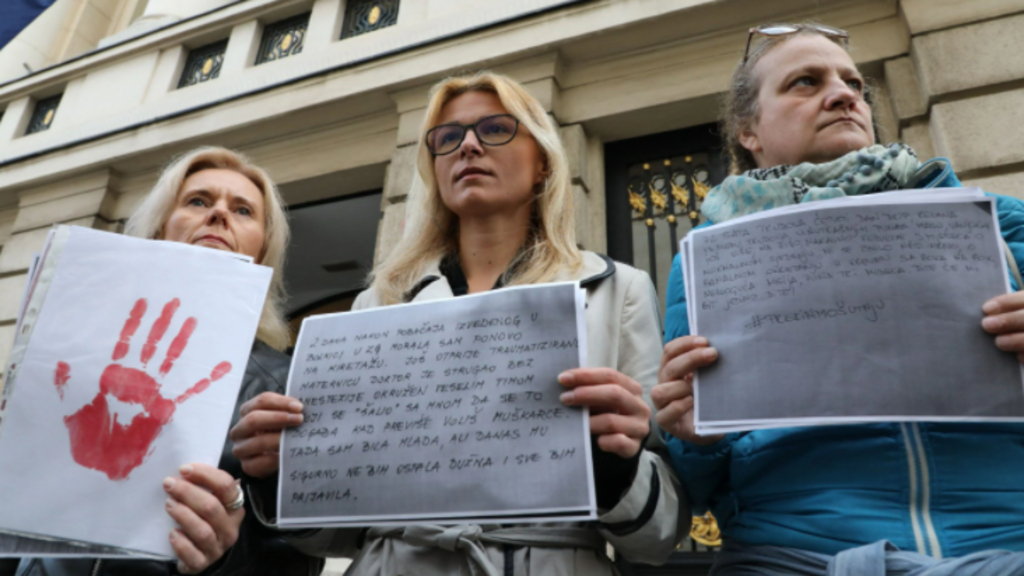
When a Serbian actress accused her former drama teacher of rape last week, the reaction was seismic: thousands of women across the Balkans have since come forward with their own stories, united under the banner “You are not alone”.
Activists hope the outpouring will leave lasting change in a region where patriarchal attitudes dominate and where previous “Me Too” movements against sexual violence and harassment have been limited in scale.
Much of the catharsis is taking place online, thanks to a new Facebook page called “Nisam Trazila,” which means “I didn’t ask for it”, created by Bosnian actresses.
“For years I have been gathering my courage to tell someone, to calm my soul, to resurrect the dead child inside me,” one young woman wrote on the page about the trauma of a sexual assault she suffered at age 14.
She and others have been emboldened by 25-year-old Milena Radulovic, the actress who broke the dam when she told her story to the Serbian newspaper Blic in an interview published on January 17.
Radulovic accused a famous 68-year-old Belgrade theater teacher and producer, Miroslav Aleksic, of raping her and abusing other students at his prestigious drama school.
Her testimony — and that of several other alleged victims — saw Aleksic arrested the following day on accusations of rape and sexual assault. He has denied all allegations.
Radulovic, who is currently based in Russia, said she was motivated to protect other students from harm.
“I feel a huge responsibility towards those children, towards society, but also towards myself. This is a thing that must be brought to an end,” she said.
Weakening the taboo
In a 2019 OSCE survey, 22 percent of Serbian women surveyed said that they had experienced physical or sexual violence at the hands of a partner or non-partner since the age of 15.
More than 41 percent also reported being exposed to sexual harassment, a figure some 10 percentage points below the European Union’s average which likely indicates a stronger “taboo” preventing women from reporting abuse, “as well as a lack of awareness about what constitutes sexual harassment”, the report said.
The reaction to Radulovic’s testimony suggests the stigma has started to weaken, thanks in part to other regional movements in recent years such as the “Justice for young girls” protests that followed the repeated rape of a teenage girl in Croatia and the “Save me” movement against domestic violence.
In Serbia, the first major “Me Too” victory was launched by Marija Lukic, a former secretary who battled public shaming to take her boss — the mayor of a small town — to court for sexual harassment and assault in 2018.
He was sentenced in July 2020 to three months in prison and taken to jail this week.
While Radulovic’s public profile added to the impact of her case — helping keep the story on front pages for days — anger and awareness has been brewing for some time.
“There is a lot of energy, frustration and fear among women and this is what is breaking out,” Marinella Matejcic, a Croatian activist from the human rights group PaRiter, told AFP.
‘Collective detonator’
In Belgrade, phones at the Autonomous Women’s Center (AZC), which has been helping survivors since 1993, have been ringing off the hook.
While the organization is accustomed to hearing reports of physical and psychological violence, its workers are now taking more calls about sexual assault, said activist Sanja Pavlovic.
Radulovic’s case served as a “collective detonator”, she told AFP.
“It has provoked the need not only to cope with the pain, but to search together for a form of justice.”
Speaking out has already helped pinpoint other potential serial abusers.
On Twitter, a collective complaint was organized against a university professor in Belgrade, while other faculties in Serbia, Croatia and Bosnia have posted forms online for students to register accusations.
In Zagreb, the dean of the Dramatic Arts faculty said the university had passed on to police some 14 complaints, mainly from former students, of “lewd acts, harassment” and other allegations against eight current employees and six former staff and other associates.
Call to change
Activists hope the movement will be translated into concrete change.
“Beyond messages of support and calls for complaints, I would like our politicians to take the initiative to change the law,” said Pavlovic.
Sexual harassment was criminalized in Serbia in 2017, but the country’s law on rape still contravenes the Istanbul Convention on combating violence against women, which Belgrade ratified in 2013.
Rape continues to be defined as “an act committed by coercion, force or threat, and not as a sexual act to which the victim has not consented,” notes Grevio, a monitoring group.
The case of Aleksic — whose academy has been closed until further notice — has also highlighted a need to look at prevention measures in schools.
A petition demanding training on “recognition, response and methods of protection against sexual violence” in Serbian schools has collected almost 10,000 signatures.
“The realization of what happened right under our noses, in an elite Belgrade school, has awakened our country, which rarely happens,” Goran Milanovic, one of the petition’s co-authors, told AFP.
“It is now that we must change, otherwise, I am afraid it is only a matter of time before we are once again confronted with such revelations”.