
• About Us
  • Who Are We
  • Work With Us
Monday, November 23, 2026
No Result
View All Result
The Globe Post
39 °f
New York
44 ° Fri
46 ° Sat
40 ° Sun
41 ° Mon
  • National
  • World
  • Business
  • Interviews
  • Lifestyle
  • Democracy at Risk
    • Media Freedom
  • Opinion
    • Editorials
    • Columns
    • Book Reviews
    • Stage
  • Submit Op-ed
  • National
  • World
  • Business
  • Interviews
  • Lifestyle
  • Democracy at Risk
    • Media Freedom
  • Opinion
    • Editorials
    • Columns
    • Book Reviews
    • Stage
  • Submit Op-ed
No Result
View All Result
The Globe Post
No Result
View All Result
Home World Middle East

Matter of Life and Death: Healthcare Costs Skyrocket for Syrian Refugees in Jordan

Staff Writer by Staff Writer
10/11/24
in Middle East, Refugees
A Syrian refugee family in Jordan

A Syrian family walk past tents at the Zaatari camp near the northern Jordanian city of Mafraq on 12 August, 2012. Photo: AFP

10
SHARES
Share on FacebookShare on Twitter

Like so many Syrian parents, Yousef fled Syria to provide a safer life for his children. But it wasn’t just the ongoing conflict that was putting his daughter’s life in danger, it was the lack of access to regular medicine and treatment facilities.

Rasha, Yousef’s 10-year-old daughter, has Sickle Cell Anemia, a hereditary blood disorder that affects hemoglobin and requires regular transfusions and costly medications.

“It was becoming increasingly difficult to reach hospitals and secure medication treatment and blood,” Yousef told The Globe Post. “This was the main reason we came to Jordan.”

Yousef and his family entered Jordan in 2014 through Syria’s southern borders. The country is usually considered an island of repose in a region suffering from wars. It has been taking in millions of refugees from Palestine, Iraq, Yemen, and Syria for many decades.

According to the United Nations Higher Commission for Refugees, Jordan has 89 refugees per 1,000 inhabitants, making it globally the second highest share of refugees compared to its population.

There are currently 650,000 Syrian refugees in the country. The government figures estimate, however, that Jordan is hosting 1.3 million of the 5.2 million Syrian refugees across the region.

“The narrative goes that Jordan is safe, stable, and has a dense network of NGOs and aid workers managing the influx of refugees and vulnerable locals in the country,” Farah Ali, a program coordinator for an NGO that works with the disenfranchised communities in the country, told The Globe Post. “This is why donor states and the international community should continue providing it funds.”

These funds have been allowing people like Rasha to continue receiving heavily subsidized treatment and medicine within the public healthcare system due to their refugee status.

But all of this is changing after a recent price hike in public health services for Syrian refugees.

Jordan’s government has recently introduced a new law requiring urban Syrian refugees to pay the same rate as other non-Jordanians in public hospitals – with 80 percent up front.

“This is resulting in fees increasing by up to five times for most services – for instance, the cost of a regular hospital birth has gone up from $85 to nearly $330,” Ali said.

Rasha’s treatment costs have skyrocketed from $8.5 to $2,800.

Yousef’s family has so far been getting by on food vouchers from the World Food program, the $150-200 Yousef makes doing odd jobs, and the $220 they receive from UNHCR.

“There is just no way I can cover these costs,” he says. “It’s impossible.”

Yousef’s family is now allocating most of their monthly income to Rasha’s blood transfusions and skipping on the medications, but it’s only a matter of time before they become an absolute necessity.

Yet, Yousef says he understands the measures.

“I wasn’t expecting the cheap healthcare to last that long – the Jordanian government is under so much pressure,” he said.

The financial strains in the country continue to worsen as Syria’s crisis enters its eighth year, and the influx of refugees to Jordan continue to rise.

Jordanian officials have refused to provide a statement explaining the change in healthcare policy, but have in the past mentioned the rising costs of Syrian refugees and falling international support a major issue.

“As healthcare needs have increased in Jordan, international donations have decreased, so it’s unsurprising that Jordan has reduced healthcare subsidies for Syrian refugee families,” Bill Van Esweld, a researcher on the Middle East and North Africa for UNHCR, told The Globe Post.

“In 2017 Jordan requested a total of $191,222,849 in aid from the international community to support its response to the healthcare needs of Syrian refugees and vulnerable Jordanians,” Esweld said. “It received $123 million.”

And only 15 percent of the funds required for health care needs of refugees were met in the first quarter of 2018.

“The international community needs to urgently work with Jordan to reverse those cuts,” Esweld said. “The majority of Syrian refugees are in poverty, and many could not afford healthcare costs even before they were increased. Until the cuts are reversed, people are going to suffer, and people will die because they cannot afford care.”

Analysis by UNHCR shows that 80 percent of Syrian refugees in urban areas live below the poverty line and the price hike will make even basic medical treatment unaffordable to most.

“Syrian families might start to opt for self-medication or other less costly alternatives instead of seeking healthcare – simply because they cannot afford to anymore,” Ali said.“It can be extremely dangerous, and relevant authorities need to come up with an appropriate and sustainable solution to this.”
Share10Tweet
Staff Writer

Staff Writer

With Contributions by AFP

Related Posts

A Syrian government flag flies above the rubble in the neighbourhood of Hajar al-Aswad near Yarmouk refugee camp on the outskirts of Damascus, Syria
Middle East

UN Security Council Convenes Over Situation in Syria

by Staff Writer with AFP
December 9, 2024
A migrant boat off the coast of Libya.
Refugees

UN Says 2023 Was Deadliest Year for Migrants in a Decade

by Staff Writer with AFP
March 7, 2024
Chinese President Xi Jinping
World

China Announces ‘Strategic Partnership’ With Syria

by Staff Writer
September 22, 2023
Myanmar Rohingya refugees look on in a refugee camp in Teknaf, in Bangladesh's Cox's Bazar, on November 26, 2016
Refugees

US Announces $26M in New Aid for Rohingya

by Staff Writer
March 8, 2023
Syrian rescuers and civilians search for victims and survivors amid the rubble of a collapsed building, in the rebel-held northern countryside of Syria's Idlib province on the border with Turkey, early on February 6, 2023. Syrian rescuers (White Helmets) and civilians search for victims and survivors amid the rubble of a collapsed building
World

Quake Kills Over 1,200 Across Turkey, Syria

by Staff Writer
February 6, 2023
Bashar Assad
Middle East

Syria Frees 60 Prisoners in Presidential Amnesty: Monitor

by Staff Writer
May 3, 2022
Next Post
A malnourished Yemeni child receives treatment

French Charity: Hundreds of Children at Risk in Yemen Battle

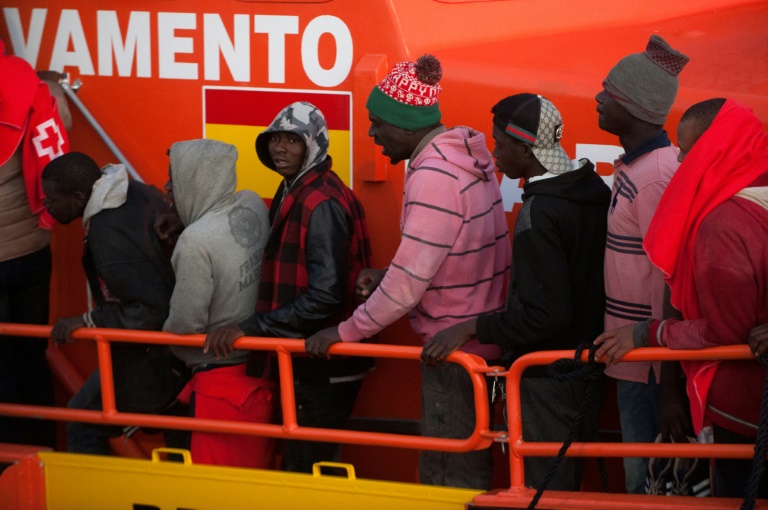
migrants in Spain

UN: People Smugglers Make Billions [Report]

Recommended

The Fnideq (Morocco) - Ceuta (Spain) fence, located in northern Africa, is one of the main borders used by people on the continent to try to immigrate to the European Union. In September 2024, a massive attempt to cross the fence occurs, and the Moroccan police push back hundreds of people who head towards the Spanish exclave. In 2024, Spain receives 46,000 migrants.

Thousands Cross Into Spain’s North Africa Enclave in New Migrant Crisis

July 31, 2026
An armed Iranian police officer holding a rifle monitors the area as motorcyclists ride beneath a billboard depicting an AI-generated image of the Strait of Hormuz and an effigy of US President Donald Trump, displayed on the wall of a state building in downtown Tehran, Iran, on May 3, 2026.

US, Saudi Strike Iraq Alliance in Expanding War

July 29, 2026
Germany, Berlin, 26 july 2026, Gathering in tribute to the victims and all those affected by the attack on the 2026 CSD (Christopher Street Day/Pride) event, held at Pariser Platz.

Berlin LGBTQ Community Fears Far-Right ‘Exploitation’ of Pride Attack

July 27, 2026
AI chatbot applications.

Trump Under Pressure From All Sides Over Chinese AI Surge

July 24, 2026
Protesters gathered to condemn the detention of opposition leader of parliament, Rahul Gandhi, during a protest in New Delhi.

India Student Protests Keep Up Pressure on Modi Government

July 22, 2026
A southern Yemeni separatist fighter waves his rifle at the site of an anti-government protest in the port city of Aden, Yemen January 30, 2018.

Yemen’s Iran-Backed Houthis Announce Maritime Blockade of Saudi Arabia

July 20, 2026

Opinion

A Cuban street with a flag

Cuba Through a Pulse: Intimacy, Poverty, and the Shadow of Revolution

March 10, 2026
An Iranian walking in front of a wall painting of the Iranian flag in Tehran

Iran Can’t Dominate the Middle East Without Iraq

January 13, 2026
US President Donald Trump

Vladimir Trump and Blood for Oil

January 5, 2026
A trial COVID-19 vaccine

America’s Global Health Retreat Is a Gift to Its Rivals

November 12, 2025
Israeli Prime Minister Benjamin Netanyahu

UN Might Tolerate Netanyahu, and White House Might Welcome Him, But He’s Still Guilty of Genocide

September 30, 2025
Former President Donald Trump speaks at a Fox News Town Hall

Cruelties Are US

August 25, 2025
Facebook Twitter

Newsletter

Do you like our reporting?
SUBSCRIBE

About Us

The Globe Post

The Globe Post is part of Globe Post Media, a U.S. digital news organization that is publishing the world's best targeted news sites.

submit oped

© 2018 The Globe Post

No Result
View All Result
  • National
  • World
  • Business
  • Interviews
  • Lifestyle
  • Democracy at Risk
    • Media Freedom
  • Opinion
    • Editorials
    • Columns
    • Book Reviews
    • Stage
  • Submit Op-ed

© 2018 The Globe Post