
• About Us
  • Who Are We
  • Work With Us
Tuesday, November 24, 2026
No Result
View All Result
The Globe Post
39 °f
New York
44 ° Fri
46 ° Sat
40 ° Sun
41 ° Mon
  • National
  • World
  • Business
  • Interviews
  • Lifestyle
  • Democracy at Risk
    • Media Freedom
  • Opinion
    • Editorials
    • Columns
    • Book Reviews
    • Stage
  • Submit Op-ed
  • National
  • World
  • Business
  • Interviews
  • Lifestyle
  • Democracy at Risk
    • Media Freedom
  • Opinion
    • Editorials
    • Columns
    • Book Reviews
    • Stage
  • Submit Op-ed
No Result
View All Result
The Globe Post
No Result
View All Result
Home Opinion

Why Does the International Community Leave Rohingya to Fate?

Vincent Auger by Vincent Auger
09/08/18
in Opinion
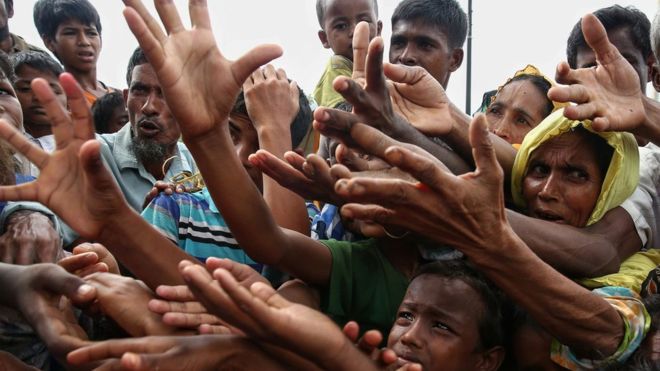
Rohingya refugees reaching for food aid at Kutupalong refugee camp in Bangladesh

Since August last year, 700,000 Rohingya have fled to neighboring Bangladesh. Photo: AFP

208
SHARES
Share on FacebookShare on Twitter

Once again, representatives of the international community express outrage over atrocities committed in Myanmar. In August last year, Myanmar’s military began to drive the Muslim Rohingya minority from Buddhist-majority Myanmar, resulting in thousands of deaths and the flight of 700,000 Rohingya to neighboring Bangladesh. Just two weeks ago, a fact-finding mission established by the United Nations Human Rights Council reported that Myanmar’s military leadership should be investigated and prosecuted for genocide and other crimes against humanity, such as targeting civilians and the use of sexual violence as a “deliberate strategy.”

As stunning as the allegations are, the UN report was hardly the first time the international community had accused Myanmar of such crimes. Within weeks of the start of the violence in 2017, other governments and UN officials were labeling the violence as genocide and ethnic cleansing. The media regularly reported graphic tales of killings and rapes of Rohingya civilians. In July, exasperated by a Myanmar diplomat’s defense of his government’s policies, the UN’s chief human rights official declared those justifications “preposterous” and asked the diplomat “Have you no shame, sir?”

How did such a catastrophe come about? Why, despite the strong words, has no one in the international community acted to protect the Rohingya or punish the government of Myanmar?

The origins of the violence can be found deep in Myanmar’s political system, where for decades the Rohingya have been described as an alien race (“Bengali”) and have been denied the rights of citizenship. The UN report characterized the situation of the Rohingya as “severe, systemic and institutionalized oppression from birth to death.”
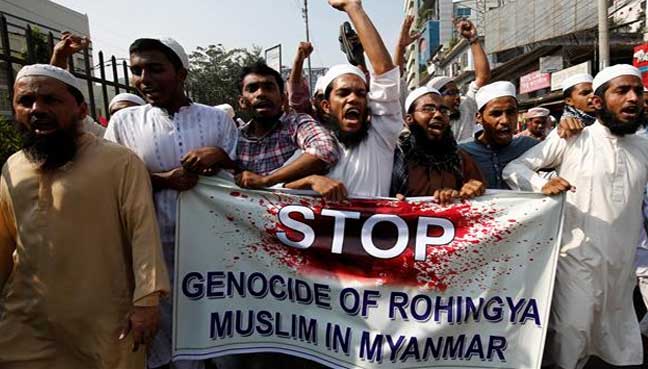
Protests in Dhaka, Bangladesh, march in support of the Rohingya that have been persecuted in neighboring Myanmar
Protesters in Bangladesh march in support of the Rohingya that have been persecuted in neighboring Myanmar. Photo: Munir Uz Zaman, AFP

This oppression has been amplified in recent years by the virulent ethnic nationalism espoused by the Myanmar military; its commander said in September last year that the ongoing operations were intended to “solve” the long-standing “Bengali problem.” The government, led by Nobel Peace Prize laureate Aung San Suu Kyi, has been unable or unwilling to call the military leadership to account or challenge the narrative justifying their actions.

What Can International Community Do?

In theory, there are two ways other states could justify intervening to protect the Rohingya. The Genocide Convention of 1948 authorizes signatories to ask the UN to prevent and suppress genocide and commits the parties to punish any person found guilty of committing genocide.

More recently, in 2005 all UN members accepted the principle of the “responsibility to protect” which provides a rationale for international intervention when a government could not or would not protect its civilian population from massive violence.

Why then the lack of meaningful action? In simple terms, the international community had other interests that they considered more important than protecting the Rohingya. No one wished to go to war with Myanmar over the issue. Powerful states in the region, such as India and China, are competing for political and economic influence in Myanmar and do not wish to alienate their powerful military.

United States officials, including then-secretary of State Rex Tillerson and Ambassador to the UN Nikki Haley, denounced the actions of the Myanmar military, and the U.S. placed some minor sanctions on the regime. However, recent press reports indicate that Donald J. Trump’s administration has not fully implemented even those weak measures. The White House remains divided over how strongly to confront the Myanmar military, especially given the lack of interest Trump has shown in the Rohingya’s plight.

The UN Security Council cannot act because China will wield its veto to protect Myanmar’s regime.

The UN fact-finding report was scathing in its criticism of how other agencies within the UN ignored human rights concerns in Myanmar to protect their access to the Myanmar government. Given this record, the UN human rights commissioner might also have cause to pose his pointed question to many members of the international community.

What can be done now? At a minimum, states and international organizations must increase the aid that they provide to the Rohingya refugees and Bangladesh. Repatriation of refugees seems unlikely at present, given the opposition of the Myanmar military, but should remain a long-term goal.
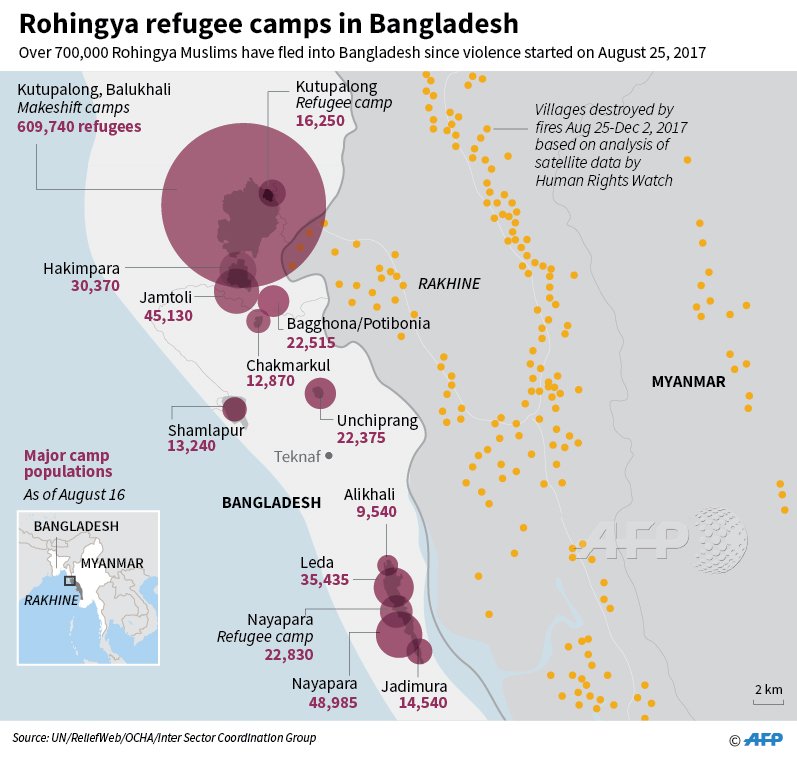
Infographic showing major Rohingya refugee camp populations in Bangladesh.
Major Rohingya refugee camp populations in Bangladesh. Image: AFP

Providing for permanent resettlement of Rohingya in other countries would give those behind the ethnic cleansing exactly what they want (the “solution” to the “Bengali problem”), but may be the best humanitarian solution for at least some Rohingya.

Warnings should be given to the Myanmar government concerning the treatment of the thousands of Rohingya who remain in Myanmar, although the international community may have little credibility given its inaction to date. An arms embargo, as suggested in the UN report, and stronger economic sanctions on Myanmar may increase pressure on the regime, but only if China agrees to comply with such measures.

Finally, apprehension and prosecution of the Myanmar military leadership for genocide and war crimes may provide some measure of justice for the Rohingya victims; once again, however, the effectiveness of this sanction depends on other states’ willingness to give it a high priority.

In the short-term, we are unlikely to see substantial relief for the Rohingya or adequate punishment for those responsible for the atrocities inflicted on them.

However, we must learn from this case – to recognize the signs of impending genocide, to deter and prevent such crimes, and to react promptly if violence does begin – in the hopes that the international community can respond more effectively next time. Because there will be a next time.
Share208Tweet
Vincent Auger

Vincent Auger

Dan and Laura Webb Professor of Political Science at Western Illinois University. Augur previously taught at Hamilton College and at the Center for Chinese and American Studies in Nanjing, China

Related Posts

Many Rohingya refugees in Indonesia enlist the help of traffickers to cross the sea to neighboring Malaysia.
World

More Than 150 Rohingya Refugees Rescued off Indonesia: UN

by Staff Writer with AFP
October 24, 2024
Myanmar Rohingya refugees look on in a refugee camp in Teknaf, in Bangladesh's Cox's Bazar, on November 26, 2016
World

Some 45,000 Rohingya Have Fled Fighting in Myanmar: UN

by Staff Writer with AFP
May 24, 2024
A Myanmar border guard
World

Northern Myanmar Fighting Displaces Almost 50,000 Civilians: UN

by Staff Writer
November 10, 2023
A bamboo-based design raises family homes safely above water levels to cope with raising water levels in Bangladesh.
Opinion

The West Owes Climate Refugees Reparations Now

by Cresa Pugh
August 14, 2023
Myanmar Rohingya refugees look on in a refugee camp in Teknaf, in Bangladesh's Cox's Bazar, on November 26, 2016
Refugees

US Announces $26M in New Aid for Rohingya

by Staff Writer
March 8, 2023
Myanmar school attack
World

Myanmar School Attack Could Be ‘War Crime’: UN Probe

by Staff Writer
September 27, 2022
Next Post
Two African shipwrecked migrants swimming toward a rescue boat in the Mediterranean Sea, off the coast of Libya

EU's Efforts To Prevent Migration From Libya Does Not Respect or Value Lives

Jimmie Akesson, the head of the far-right Sweden Democrats

Immigrants Anxious Over Rise of Swedish Far-Right

Recommended

The Fnideq (Morocco) - Ceuta (Spain) fence, located in northern Africa, is one of the main borders used by people on the continent to try to immigrate to the European Union. In September 2024, a massive attempt to cross the fence occurs, and the Moroccan police push back hundreds of people who head towards the Spanish exclave. In 2024, Spain receives 46,000 migrants.

Thousands Cross Into Spain’s North Africa Enclave in New Migrant Crisis

July 31, 2026
An armed Iranian police officer holding a rifle monitors the area as motorcyclists ride beneath a billboard depicting an AI-generated image of the Strait of Hormuz and an effigy of US President Donald Trump, displayed on the wall of a state building in downtown Tehran, Iran, on May 3, 2026.

US, Saudi Strike Iraq Alliance in Expanding War

July 29, 2026
Germany, Berlin, 26 july 2026, Gathering in tribute to the victims and all those affected by the attack on the 2026 CSD (Christopher Street Day/Pride) event, held at Pariser Platz.

Berlin LGBTQ Community Fears Far-Right ‘Exploitation’ of Pride Attack

July 27, 2026
AI chatbot applications.

Trump Under Pressure From All Sides Over Chinese AI Surge

July 24, 2026
Protesters gathered to condemn the detention of opposition leader of parliament, Rahul Gandhi, during a protest in New Delhi.

India Student Protests Keep Up Pressure on Modi Government

July 22, 2026
A southern Yemeni separatist fighter waves his rifle at the site of an anti-government protest in the port city of Aden, Yemen January 30, 2018.

Yemen’s Iran-Backed Houthis Announce Maritime Blockade of Saudi Arabia

July 20, 2026

Opinion

A Cuban street with a flag

Cuba Through a Pulse: Intimacy, Poverty, and the Shadow of Revolution

March 10, 2026
An Iranian walking in front of a wall painting of the Iranian flag in Tehran

Iran Can’t Dominate the Middle East Without Iraq

January 13, 2026
US President Donald Trump

Vladimir Trump and Blood for Oil

January 5, 2026
A trial COVID-19 vaccine

America’s Global Health Retreat Is a Gift to Its Rivals

November 12, 2025
Israeli Prime Minister Benjamin Netanyahu

UN Might Tolerate Netanyahu, and White House Might Welcome Him, But He’s Still Guilty of Genocide

September 30, 2025
Former President Donald Trump speaks at a Fox News Town Hall

Cruelties Are US

August 25, 2025
Facebook Twitter

Newsletter

Do you like our reporting?
SUBSCRIBE

About Us

The Globe Post

The Globe Post is part of Globe Post Media, a U.S. digital news organization that is publishing the world's best targeted news sites.

submit oped

© 2018 The Globe Post

No Result
View All Result
  • National
  • World
  • Business
  • Interviews
  • Lifestyle
  • Democracy at Risk
    • Media Freedom
  • Opinion
    • Editorials
    • Columns
    • Book Reviews
    • Stage
  • Submit Op-ed

© 2018 The Globe Post