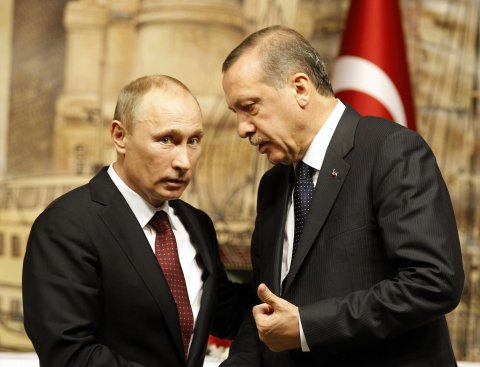


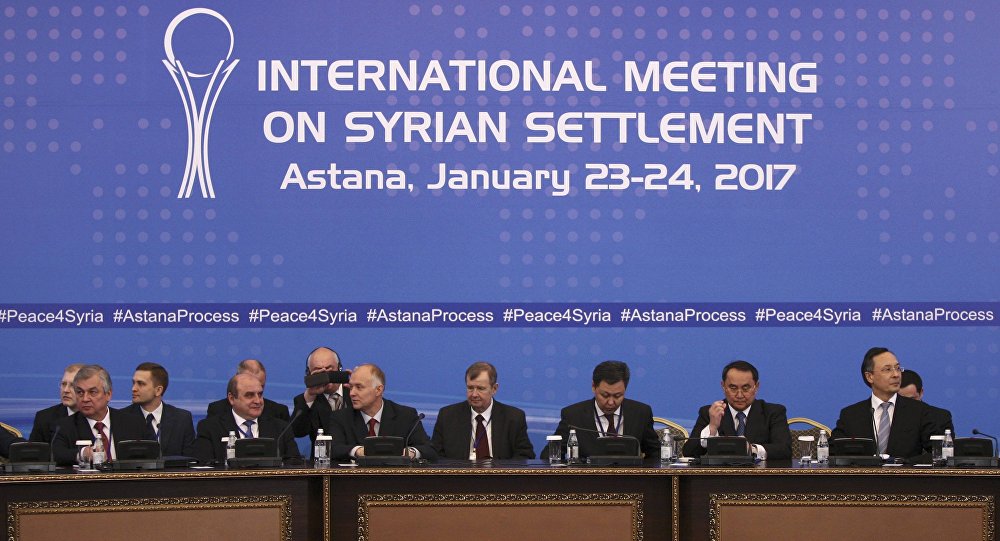
Turkey, Russia and Iran have reached an agreement to set up a mechanism to monitor fragile cease-fire amid revival of fighting on the ground in western parts of Syria, capping days of wrangling between the Syrian opposition and the regime in Astana.
The three powers agreed to build a mechanism “to observe and ensure full compliance with the cease-fire, prevent any provocations and determine modalities of the ceasefire,” Reuters quoted Kazakhstan’s Foreign Minister Kairat Abdrakhmanov as saying.
Russia and Turkey emerged as two main actors, which initiated the latest diplomatic effort that runs against a myriad of challenges and pitfalls. While the communique mentions about a mechanism to oversee the implementation of the truce, it does not elaborate on how it would enforce it. The ambiguity offers an additional layer of caution amid already low expectations that pervaded international community and diplomats present in Astana.
The first day of the talks got off to a rocky start as representatives of rebel groups and the Syrian government relapsed into a series of mutual recriminations, speeches laced with rants and insults. Syrian delegation head Bashar al-Jaafari called the opposition “armed terrorist groups,” a label Damascus uses to identify fighting rebel groups regardless of whether they are hardline or moderate ones.
Representing Army of Islam, Mohammad al-Alloush described the government as a “bloody, despotic regime” in an opening remark on the first day. He demanded the release of 13,000 women prisoners by Bashar al-Assad regime and also end of starvation sieges, a tactic that was frequently employed as a new warfare to collectively punish entire population in a rebel-held territory.
“The presence of foreign militias invited by the regime, most notably the Lebanese Hezbollah and the Iraqi Hezbollah … contributes to the continuation of bloodshed and obstructs any opportunity for a cease-fire,” the Associated Press quoted Mr. Alloush as saying.
What differentiates the latest diplomatic push from a number of earlier initiatives is the fact that the Syrian government delegation held direct meeting with representatives of a dozen of armed groups around a table for the first time. For a government that never changed its narrative on armed rebels by blanket type of description of all as “terrorist groups,” the first meeting on Monday represented an unprecedented step.
Though Astana talks never aimed at a broader political settlement, it mostly focused on cessation of hostilities on the ground ahead of Geneva meeting in February. Turkey, Russia and Iran reiterated their commitment “to the sovereignty, independence, unity and territorial integrity of the Syrian Arab Republic as a multiethnic, multi-religious, nonsectarian and democratic state,” the New York Times reported. This is also reinforced by another conviction that there is no military solution to the Syrian conflict, which raged on for almost 6 years, killing nearly half a million people.
The U.S., which conceded ground to Russia in leading diplomatic efforts to resolve the Syrian deadlock, welcomed Astana talks. “The United States remains committed to a political resolution to the Syrian crisis, which can bring about a more representative, peaceful, and untied Syria, free of terrorism and extremism,” State Department Spokesperson Mark Toner said.
There will be new round of negotiations between the Syrian opposition and the Assad regime next month in Geneva following a previous scheme envisaged by the United Nations. In Astana, U.N. Special Envoy Staffan De Mistura acted as an intermediary and shuffled between rooms to mediate divergent demands and opinions from warring sides. The core of the dilemma revolves around the fact that neither the opposition nor the Syrian government signed the communique, leaving observers wondering how 3 countries would enforce the partial truce that flagrantly violated by Damascus numerous times.
Astana talks witnessed emergence of Russia as a key powerbroker, which aims to expand its sphere of influence in the Middle East by resolving the Syrian conflict. But while Moscow’s air support proved to be a game changer that helped Mr. Assad’s forces turn the tide of war after a costly victory in Aleppo, Russia’s ability to end the bloodshed in its entirety, or even persuade Damascus to comply with the truce seems to be palpably limited. What is clear, however, is the fact that Turkey, a key sponsor of the rebel cause, shifted more toward Russia’s position in Syria, a significant achievement both for Moscow and Damascus.
Turkey has abandoned its unflinching stance on removal of Mr. Assad as a precondition for any political solution, and agreed to accept the Syrian president, a figure whose very name associated with atrocities in Syria in the eyes of Turkish people and politicians alike.
Speaking to leaders of business world at World Economic Forum in Davos last week, Turkish Deputy Prime Minister Mehmet Simsek went off the script by revealing how much the mood and outlook in Ankara changed regarding the Syrian conflict. He publicly acknowledged that a solution without Mr. Assad would not be realistic. While Ankara later tried to tailor those remarks to appease domestic constituency, audio record of Mr. Simsek’s speech requires no need for further clarification.
Turkey revamped its Syria strategy and scaled back its lofty ambitions in line with the fast-changing realities of the ground. For Ankara, keeping Syrian Kurdish militia in check is a far urgent need to prevent formation of a Kurdish statelet on the Syrian side of the border than pressing for removal of Mr. Assad from power. This sea change in the Turkish position came to the fore in Ankara’s re-alignment with Moscow to solve the conflict that sent 3 million refugees to Turkey, straining the country’s resources to accommodate the Syrians.
Ankara’s unwavering opposition left the Kurds out of equation in Astana talks. The Kurdish People’s Protection Units (YPG) militia is among the groups that also have been excluded from cease-fire.
Syria’s complex battleground always contains risk of accidental and unwanted encounters between outside powers in a web of proxy wars that ruined the country. Syrian forces’ advance to al-Bab may trigger a confrontation with Turkey-backed rebels, and even the Turkish troops battling to capture the strategic town located north of Aleppo.
While recent discourse from Ankara over its new Syrian policy toward Damascus seems to be encouraging for a dialogue, al-Bab remains as a source of potential conflict between Turkey and Syria. Turkish Deputy Prime Minister Numan Kurtulmus ruled out media reports that Turkey will hand over the town to Damascus once it seizes from Islamic State militants.
The Turkish forces bogged down in a prolonged siege of al-Bab amid steady rise of casualties. Last week, 5 more Turkish soldiers were killed in an ISIS attack, bringing death toll more than to 50.