

Turkey’s rotten judicial system, gutted press freedom and gross human rights violations have been dramatically exposed during a hearing on Turkey by U.S. House Committee on Foreign Affairs.
House Committee On Foreign Affairs, Subcommittee on Europe, Eurasia, And Emerging Threats Hearing held a special session under the title of “Turkey’s Democracy Under Challenge” on Wednesday.
David Philips from Columbia University; Ali Cinar, President of Turkish Heritage Foundation, an institution affiliated with the Turkish government; Mehmet Yuksel, People’s Democratic Party’s (HDP) Representative to the U.S.; and Naz Durakoglu, a strategist and senior fellow at Digital Forensic Research Lab of Atlantic Council offered in-depth analysis of what is happening in Turkey.
“Turkey is called as a secular democracy. Turkey is neither secular nor a democracy,” Mr. Philips said.
“If the referendum passes on April 16, formalizing anti-democratic governance, the date will mark the death of Turkey’s nascent democracy,” he added, providing a disheartening portrait of Turkey’s slide to authoritarianism.
In his testimony to the committee, Mr. Philips addressed a number of points that describe a gutted socio-political landscape in Turkey in recent years.
Islamism, corruption, freedom of expression and assembly, freedom of the press, terror ties, relations with the EU and NATO, and minority rights (Kurds, Armenians, and Greeks) are among the central topics he dwelt upon in an in-depth fashion, offering stark warnings and portraying a dismal picture about Turkey.
As Turkey’s allies repeatedly find themselves with the need to tread a delicate balancing act, adopting a measured diplomatic tone with regard to worsening state of democracy and human rights in the country, they place their caution on the ground that Turkey is a stalwart NATO ally that takes on terrorist groups in the Middle East, an indispensable partner in the joint fight against terrorism.
Here, Mr. Philips appeared reserved against such a rationale, offering a rigorous questioning of Turkey’s credentials for being a reliable ally.
He said NATO is more than a security alliance, “a coalition of countries with shared values.”
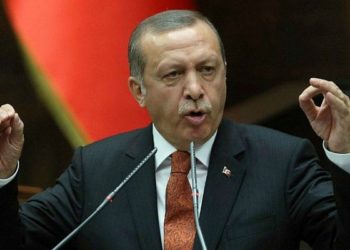
“Turkey under Tayyip Erdogan is an uncertain ally. Turkey is Islamist, anti-democratic, and a serial abuser of human rights,” said Mr. Philips who worked as a consultant leading reconciliation efforts between Turkey and Armenia for 4 years.
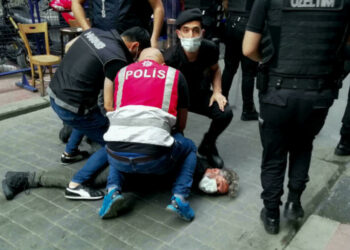
During his testimony, he talked about how media freedom is systematically gutted by the government crackdown, and how Turkey’s democracy replaced with a more toxic, authoritarian form of governance.
He cited a Freedom House report on Turkey, saying that “Turkey does not have a free press.” “Turkey remains top of Twitter’s global censorship list,” he said, referring to a Twitter report.
“Erdogan called imprisoned journalists “terrorists, child molesters, and murderers,” Mr. Philips said of the Turkish president’s latest incendiary remarks reviling the imprisoned journalists.
Mr. Philips who led a Columbia University team that tracks down Turkish government’s links to radical warring groups in Syria also delved into the claims of collusion between the Islamic State and Ankara. Turkey’s main intelligence organization “MIT established an infrastructure for supporting jihadists, ranging from weapons transfers to logistical support, financial assistance and medical services,” he said.
He went further to claim about cooperation between Mr. Erdogan’s family and ISIS for oil sale, an issue that was previously exposed by Wikileaks which released more than 15,000 emails of Berat Albayrak, President Erdogan’s son-in-law and Turkey’s Energy Minister.
HPD representative gave a detailed assessment of Ankara’s policies in Kurdish southeast, mapping out the human cost of escalated war between the Turkish security forces and the Kurdish militants.
The prolonged fighting left a heavy toll on cities, led to a surge in civilian casualties and collapse in basic infrastructure in urban areas as tens of thousands of homes were destroyed.
He urged the U.S. officials to pay close attention to the deteriorating situation on the ground, citing mounting political clampdown on Kurdish politicians as thousands of party officials, including its co-chairs, were imprisoned, while the government also strangled the Kurdish press.
Half a million of people have been internally displaced, he said, adding that more than 10,000 civil servants of Kurdish origin have been suspended from public service.
“The constitutional amendments that are proposed by President Recep Tayyip Erdogan and the ruling AK Party projects an authoritarian system of governance, whereby absolute power is held by a single person,” he said of the constitutional change which Kurds believe will usher in a one-man rule in Turkey.
Ali Cinar of Turkish Heritage Foundation presented a testimony in stark contrast with other speakers, defending the Turkish government with an unwavering conviction.
When faced questions from U.S. congressmen and lawmakers, he appeared unapologetic regarding the imprisonment of more than 150 journalists, adopted a government line, describing them as terrorists. He argued that those journalists were jailed over propaganda on behalf of terrorist organizations, rather than the conduct of journalism.
But Mr. Cinar’s arguments did little to persuade the members of the U.S. House Committee. They kept asking questions, digging to find out how Mr. Cinar would legitimize the government assault on media which took place well before the July 15 coup, not just efforts to muzzle critical voices in the media after the coup.
The Turkish government cited security reasons for targeting of media members in the aftermath of a failed coup attempt. But the trampling on press freedom harks back to months and years before the coup, culminated in the full-scale crackdown on media by the shutdown of 150 media outlets after July military insurrection.
Months before the coup, the authorities confiscated newspapers critical of the government. Mr. Cinar appeared unconvincing and unable to offer a satisfactory explanation that would legitimize the government actions against media.
Mr. Philips underlined that the government’s repressive take on media started with Gezi Protests during 2013 summer, and accelerated after the outbreak of a sweeping corruption scandal that shook Mr. Erdogan’s government to its core.
And especially after the graft scandal that implicated President Erdogan’s family members, close associates, and cabinet ministers in late 2013, the government began to employ draconian measures to stifle independent and critical media.
Anybody who dares to report about Mr. Erdogan’s link to corruption, he noted, may end up in jail.
Ms. Durakoglu spoke about the U.S.-Turkey relations, the upcoming offensive against ISIS in Raqqa and the obstacles that hobble an efficient cooperation between the two NATO allies in Syria.
********
This article was possible thanks to your donations. Please keep supporting us here.