

Last week’s parliamentary elections in the Netherlands resulted in a resounding victory for the nativist populist PVV. The party has been a significant player in Dutch politics since 2006, but the success it achieved last week is of historic proportions.
The PVV accumulated 37 of 150 seats, which is a true landslide in an election that sees 15 parties obtain parliamentary representation.
The 37 also far exceed the 26 seats the LPF obtained back in 2002, which so far had been the biggest success for a populist right party in Dutch political history.
Dutch Right-Wing Swing?
Both inside and outside the Netherlands, there have been concerned responses, for understandable reasons. The anti-immigrant and in particular anti-Islam PVV has long ran on a divisive platform advocating human rights violations for minorities.
This year’s campaign manifesto includes proposals to refuse all future asylum migration; withdraw from the UN refugee convention; reinstate border controls despite the EU’s freedom of movement; criminalize undocumented status; and prohibit Islamic schools, Qurans, and mosques in the Netherlands.
While it is difficult to speculate about explanations before high-quality election surveys become available, interpreting the PVV’s success as a sign of a large right-wing or xenophobic swing in Dutch public opinion seems unconvincing.
The more likely explanation is that many of those who voted PVV did so to express discontent with the incumbent government. It probably helped as well that PVV leader Geert Wilders maintained a milder tone in this campaign, and that the new leader of the center-right VVD – unlike her predecessor – expressed interest in entering a coalition government with the PVV.
Issues Over Ideology
For one thing, extensive electoral research has documented that voters are more prone to cast their ballot on the basis of issues rather than on the basis of ideology, and increasingly so.
In other words, voters are more likely to vote for a party they think is concerned about an issue that worries them than to attempt to identify which party best matches their own political ideological profile. This means that the result might show that Dutch voters are worried about immigration, but not necessarily that they favor Wilders’ precise policy suggestions.
Survey Data on Xenophobia
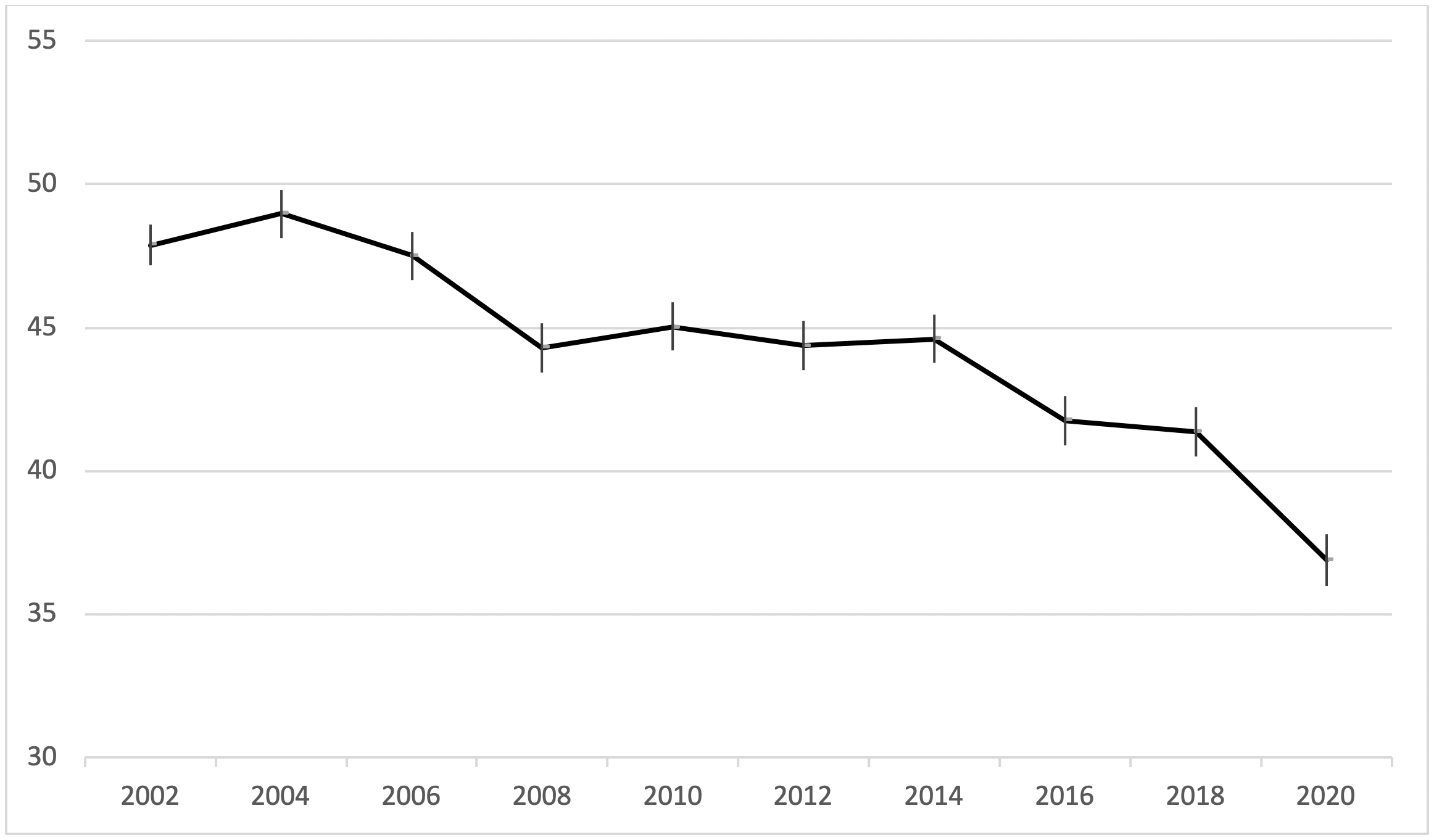
Moreover, longitudinal survey data show little evidence of a systematic increase in xenophobia among Dutch respondents.
By means of illustration, the graph below plots an estimate of xenophobic attitudes in the Netherlands based on data from the European Social Survey from 2002 to 2020.
(The estimate is based on a combined measure capturing whether respondents object to admitting immigrants from a different race, the same race, and from poorer countries outside Europe; as well as whether respondents believe immigration increases crime problems, is bad for the economy, and makes the country a worse place to live.)
Clearly, support for such statements has gone down over the last two decades.
Floating Voters
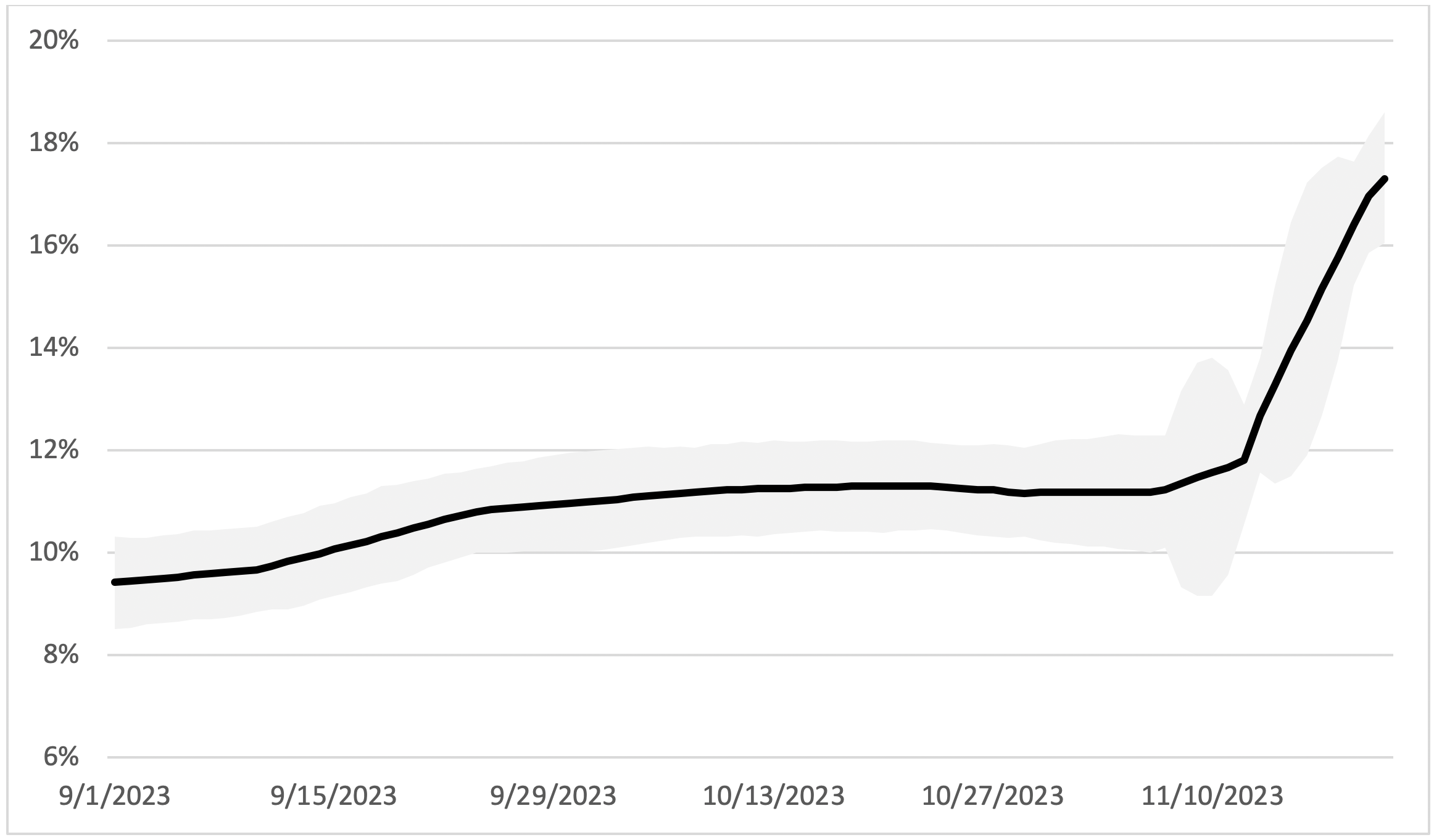
Indeed, the popularity of the PVV seems much too sudden to reflect any structural changes in public opinion. As little as a week before the elections, polls were still predicting the party to win some 20 seats and finish in fourth.
The graph below shows polling results since September from the authoritative Peilingwijzer, which combines two of the most high-quality polls that are regularly conducted in the Netherlands. The PVV win came out of nowhere, only really gaining momentum a week ago.
Note as well that in the actual result, the PVV garnered close to 24 percent of the vote, far above the predicted support in the polls one day before the election. A key explanation is that many voters only made up their mind on election day itself– which of course further undercuts the suggestion that the results reflect structural changes in Dutch public opinion.
‘Anything-but-VVD’ Logic
This leads us to the more plausible interpretation of Wednesday’s results as a function of widespread opposition to the incumbent government.
Since 2010, the Netherlands has continuously been governed by coalition governments spearheaded by Prime Minister Mark Rutte and his center-right VVD, and the country has seen its fair share of political crises and scandals during this time.
The current government parties (the VVD, the social liberal D66, and the Christian democratic parties CDA and CU) jointly lost almost half of their seats (from 78 to 41), whereas the three parties that have become the face of challenging the existing order (apart from the PVV, the newly formed NSC of whistleblower Pieter Omtzigt and the agricultural interest party BBB) saw their support almost tripled (from 18 to 64 seats).
A good portion of the electorate might have been driven by an “anything-but-VVD” logic, making any party that could realistically overtake the center-right as the largest party an attractive option. By that logic, the PVV was simply in the right place at the right time.
Consequences of Dutch Elections
In sum, then, we should resist alarmist evaluations depicting the Dutch population as suddenly much more xenophobic than in the past. At the same time, we cannot lose sight of the possible consequences of Wednesday’s results. Two are particularly important.
First, the election results will make it difficult to form a new government. This is not only because of the large fragmentation in the result in the first place, but also because the center-right VVD declared on Friday that it refuses to enter any coalition, and because left-wing and center-left parties will refuse to enter a coalition with the PVV.
Second, even if the election result does not reflect increased xenophobia in the electorate, it certainly provides a strong mandate for restrictive policy change. If we do end up seeing the PVV in government, we have to expect restrictions in immigration and integration policies where possible, not to mention a much more punitive and accusatory tone on these issues coming from The Hague.
Especially in a scenario with Wilders as prime minister, the next government will certainly both seek and push the boundaries of what is legally possible and politically acceptable.
Disclaimer: The views and opinions expressed here are those of the author and do not necessarily reflect the editorial position of The Globe Post.