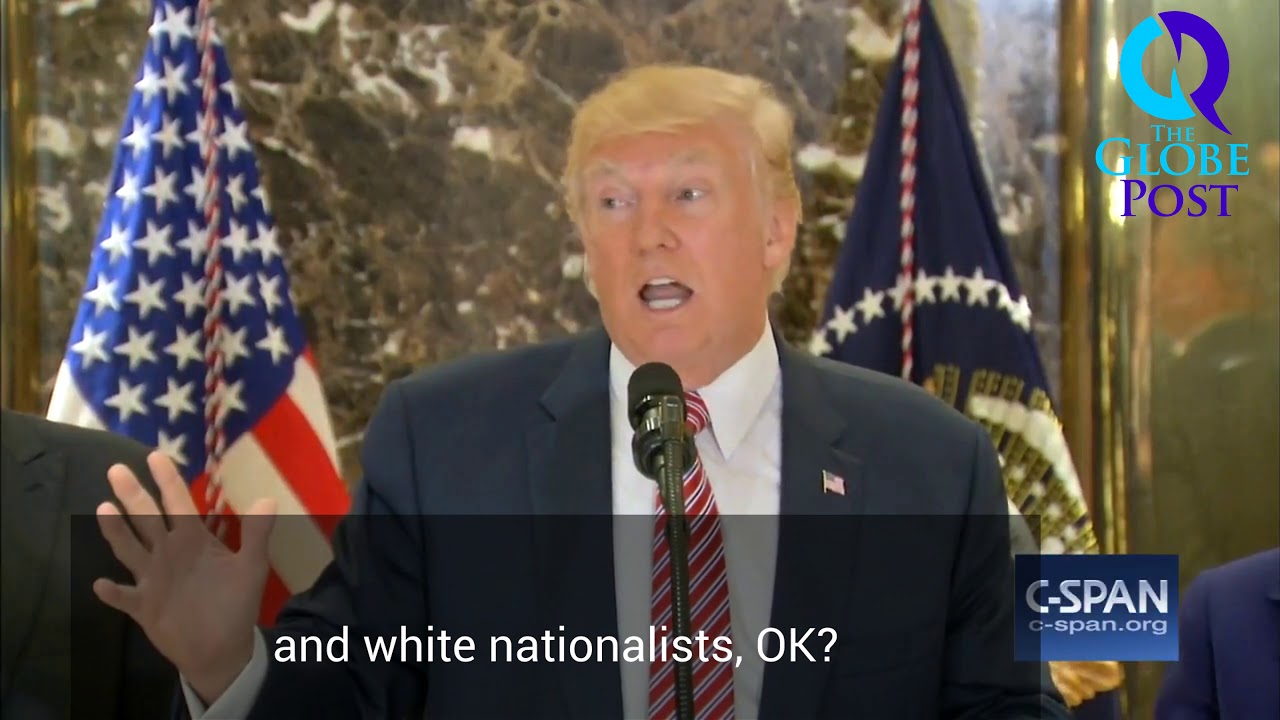



President Donald J. Trump’s weak disavowal of the violence in Charlottesville, Virginia is indicative of the all too cozy relationship that exists between the president and white nationalists.
Chief White House strategist Steve Bannon turned Breitbart.com into a white nationalist news platform, for example. White House aide Sebastian Gorka was photographed wearing a medal associated with Miklos Horthy the Hungarian World War II leader who witnessed the murder of 600,000 Jews in Hungary.
Stephen Miller, a speechwriter for the president, had ties to white supremacist Richard Spencer while at Duke University. The reality is that the president’s embrace of white nationalism presents the United States with a “Birmingham Moment.” This moment references a not altogether different civil rights crisis that played out in Birmingham, Alabama in 1963 — there is a disturbing continuity in how America once again must decide how it will respond to racism.
As Martin Luther King argued from the Birmingham City Jail, the stakes of allowing racial hatred to win are too high and too dangerous to assume that progress toward civil rights is inevitable with the passage of time. We can no longer sit on the sidelines and allow white nationalists to infiltrate the highest levels of U.S. government.
In 1963 Martin Luther King Jr., and the Southern Christian Leadership Conference led a campaign to end segregation in Birmingham’s downtown business district, integrate public parks and institute fair hiring practices in the city. The campaign was perhaps the most important model of the power of direct action.
King called this “constructive nonviolent tension” and it shocked the nation into consciousness about racism. America’s television screens were filled with images of non-violent and mostly young protesters beaten by police, and fire hoses being turned on activists seeking to end the divisions that had characterized American society for so long.
The images and the protests presented every American — rich and poor, black and white, rural and urban — with a choice: would they stand on the sidelines and on the side of the worst impulses of American society, or would they stand on the side of justice, of equality, of shared national sacrifice to honor rather than break the promise of true democracy.
More than 50 years later in a supposedly post-racial and post-civil rights America, when it has become almost routine to see Mr. Trump’s supporters physically assaulting Black Lives Matter protesters at rallies. We hear calls to ban men and women of the Muslim faith from America, a direct assault on King’s idea that “[w]e are all caught in an inescapable network of mutuality, tied in a single garment of destiny.”
Across U.S. cities, people of color face racialized violence and intimidation from the police, another poignant and lethal example of this generation’s Birmingham moment. Like our counterparts in 1960s Alabama, we have the power and responsibility to be shaken by these images and moved to political action. As King wrote from his jail cell, “freedom is never voluntarily given by the oppressor; it must be demanded.”
A decade from now we will either look back and know that Americans of all political stripes, of all faiths, races, ethnicities, and genders were willing to stand together to oppose hate and racism or we will look back and know we failed.
As King wrote: the great impediment to freedom in the United States “is not the Ku Klux Klanner, but the white moderate, who is more devoted to “order” than to justice; who prefers a negative peace which is the absence of tension to a positive peace which is the presence of justice.” As a start, America must confront Donald Trump’s deep ties to white nationalism and demand that Bannon, Miller and Gorka be removed from their White House positions. Failure to act is all the evidence needed to know why he refuses to confront white nationalism in the United States.
Disclaimer: The views and opinions expressed here are those of the author and do not necessarily reflect the editorial position of The Globe Post.