

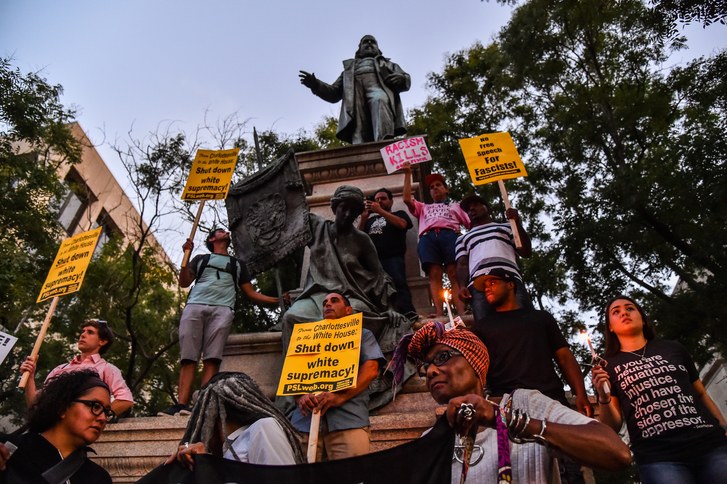
The most recent act of domestic terrorism occurring in Charlottesville, Virginia perpetrated by white nationalists is yet another grim example of the long shadow cast by doctrines of white supremacy in shaping the cultural landscape of the country and the psyche of the American people.
The lingering effects of white supremacy, operating much like an infectious disease, go into remission and flares up from time to time depending upon the changing societal context. With each new outbreak, it is the one time we can expect American officialdom to forgo partisan concerns and speak in a unified voice denouncing these horrific acts. Whether committed by individuals or groups have gone amuck, they are labeled as anomalies or tragic outcomes of untreated mental illness that are in no way representative of the views embraced by the general American public.
Despite this characteristic narrative, the truth is that horrific acts of systematic terrorism are very much American, and have been commonly used to support doctrines of white supremacy throughout the history of the United States beginning with Indian removal and the enslavement of blacks.
Keeping pace with the times, the tools of terrorism have had a changing face, ranging from the massacre and slaughter of Indians, the brutality of slavery, the lynching and cross burnings of the Jim Crow years, the Bull Connor tanks, attack dogs, fire hoses used during the 1950s and 1960s, the police brutality and mass incarceration of the later decades of the 20th century, to last week’s 21st century innovation of plowing a car into a crowd of innocent people.
The advancing of a false narrative that denies that this has been a part of the American experience reinforces the cognitive dissonance that makes it possible for beliefs about the inherent superiority of whites to comfortably coexist in a society based on democratic ideals. Concurrently, the collective amnesia that has distorted or erased knowledge of the violence perpetrated against groups defined as “the other” at various historical periods reinforces national resistance to confront the inconvenient truth that doctrines of white supremacy are deeply embedded in the nation’s institutional structures that shape the socialization experiences of Americans and internalization of cultural norms and beliefs—that in America on matters of race, assigns privilege and disadvantage on the basis of skin color.
Stroking the flames of white fear
It is these unspoken myths of white supremacy and fanning the flames of white fear that paved the way for the “Trump Phenomena.” Subliminal messages embedded in promises to make America great again, and take America back appealed to internalized feelings of white privilege beguiling a segment of the nation’s white electorate into believing that it was possible for racist ideology to again move into the mainstream.
In appealing to hopes of making America white again, and to a time when those who were considered “less than” knew and kept their place, Mr. Trump and his surrogates justified a mindset of blaming others, unsurprisingly people color, for the plight of whites who felt abandoned by its government.
Emboldened by racially coded rhetoric from the White House, this myth of white superiority, combined with population and demographic shifts where whites were losing their place as the numerical majority, and access to the American Dream is being expanded to include under its umbrella new populations largely comprised of black and brown peoples, are playing a significant role in contributing to what sociologists refer to as tipping point. When applied to race relations this dynamic explains the white backlash that put Mr. Trump in the White House and is driving the alarming increase in hate crimes and acts of violence that have intensified since he assumed office.
Moral leadership from Washington matters
Given Mr. Trump’s expressions of bigotry, vulgarity, and bullying that revealed his character and told us what he stood for long before he began his presidential campaign, during the campaign, after his election and since moving into the Oval Office, not once but over and over again. In his words “I could stand in the middle of 5th Avenue and shoot somebody and I wouldn’t lose voters.” His response to the events in Charlottesville, therefore, is not surprising.
While the optics of the violence occurring in recent events were reminiscent and equally disturbing as those of the Civil Rights Movement of the 1950s and 1960s, the responses from the White House were profoundly different.
In the midst of a country that was being turned on its head by unprecedented acts of racial violence, President John Kennedy in his 1963 address to Congress, elevated the issue of racial injustice to one of morality and appealed to all Americans to examine their consciences. President Trump was slow to condemn the violence in Charlottesville. Moreover, his first half-hearted delivered public statement reinforced the false narrative by inferring an equivalency between protests carried out under the banner of white nationalism, and those rejecting the “isms” in its many forms, and called for the equal treatment of all racial, ethnic and religious groups.
Contrary to Mr. Trump’s equivocations, the Republican leadership quickly denounced the violence and the cause of white nationalism. Yet, when looking back on the explicit racism surrounding the presidency of Barack Obama, the nation’s first African American president, it is a fair appraisal to conclude that government officials are no more immune from the effects of white supremacy than the general American public.
There is a long list of credible evidence of the racism President Obama faced when in office. Most notably among these include the fixation on making his a one-term presidency resulting in the Republican squandering of eight years that could have been productively used to shore up the Affordable Health Care Act, the signature legislation of his administration. Still refusing to give up, despite the unsuccessful in efforts to nullify his presidency while he was in office, there has been little pushback from the Republican leadership against the stream of executive orders that are being used not to promote the common good, but to erase Mr. Obama’s accomplishments.
Indeed, to make his term the “invisible presidency.” And despite controlling all branches of government, this single-minded preoccupation on undoing progressive policies advanced over the Obama years has crippled the Republican party’s ability to effectively govern and enact legislation that promotes the interests of the American people.
With some exceptions, Republicans have remained in lock step with the president for reasons of political expediency and have not called him out as he nurtures the polarization of Americans and sets about the deconstruction of the American administrative state as described by his senior advisor Steve Bannon. The country must wait and see if Republicans will again rationalize his behavior and provocative statements as the misstep of an unconventional president who is a novice to politics and once again look the other way.
Looking ahead
Right siding centuries of social injustices that are the legacy of white supremacy has never been without costs. Nor will it be possible to even the playing field by reforms that involve, or at least the perception, of making some groups better off at the expense of others. This is arguably the root cause of the acrimony and deep divisions among Americans today. And it is highly likely that the cycle of the resurfacing again and again of violence that historically accompanied efforts to eradicate remnants and symbols of white supremacy from American life will continue.
Nonetheless, these efforts must not be abandoned. The creation of a more perfect union as the historical record illustrates has never been easy.
Democracy is an aspirational and ongoing process, that on matters of race, unfortunately, is most often violent. As we live under the surrealism of the Trump administration, as President Kennedy asked the country to examine their conscience in the midst of the racial violence spawned by the fight for black civil rights, Americans might well do the same today to ask themselves how an individual who himself speaks in the voice of a white supremacist was elected to the office of the American presidency.
Returning to the metaphor of an infectious disease, this latest outbreak of domestic terrorism can be a pivotal point in the country’s history, signaling a peaking and breaking of fever spawned by the sickness of bigotry and hatred, opening a window for an authentic examination of the underlying reasons why white supremacy has had such staying power in this country, that in turn can begin a true process of healing.
Disclaimer: The views and opinions expressed here are those of the author and do not necessarily reflect the editorial position of The Globe Post.