

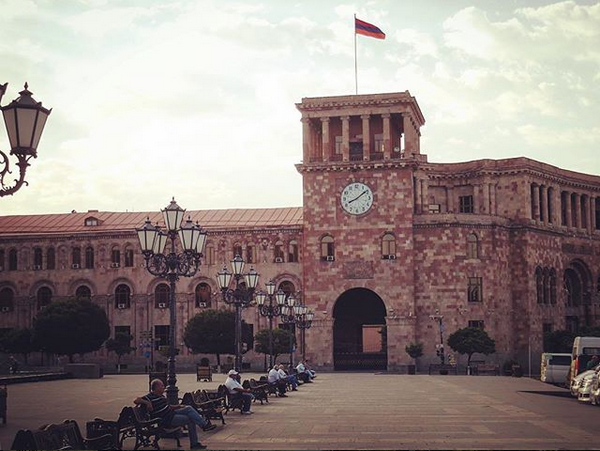
The direction of Armenia’s foreign policy is ambiguous as a result of the recent mobilization of Armenian civil society, and the resignation of two-term President-turned-Prime Minister Serzh Sargsyan.
At present, we don’t yet know the extent to which the velvet revolution that opposition leaders called for, and popular protest spearheaded, will succeed beyond their initial demand. It is also unclear whether it will proceed to transform national political arrangements and subsequently alter foreign policy. To do so would require more than a PMs resignation.
It would require a fundamental shift in the makeup of parliament as a result of free and fair elections that jettison the ruling Kremlin-linked Republican Party and usher in a resolute pro-western party with charismatic leadership on a scale akin to Mikhail Saakashvili’s National Movement and Georgia’s 2003 Rose Revolution.
A vibrant, post-Soviet generation of youth are emerging to demand an end to stagnant Soviet practices in Armenia, including corruption at every level of society, economic mismanagement that is leading to a worsening emigration crisis, and negligence of national security amid continuing territorial disputes and low-intensity levels of conflict (LILC) at the Nagorno-Karabakh (NK) border.
Their movement for reform can achieve a more fundamental shift in the trajectory of Armenian foreign policy. Georgia and other post-Soviet states have taught us that a political reorientation can occur quite quickly, but there are unique factors at play in Armenia that may make this change a longer struggle.
Armenia has remained incredibly close to Russia in the post-Soviet period. Their security and economy are dependent on Russia for weapons acquisitions, monetary loans, and imports. Under the ruling Republican Party, this status quo has remained. Domestic policy decisions are made by Serzh Sargsyan and a small group of leaders that originate from the Soviet-era, fought in the war for NK, and transcended the collapse of the Soviet Union to remain in power under tumultuous and suspicious circumstances.
Foreign policy decisions, however, are made in Moscow or under pressure from Moscow, where the Collective Security Treaty Organization (CSTO) Armenia is a member of is headquartered.
Armenia is one of the few nations to recognize the legitimacy of the Russian-annexed Crimea. Additionally, Sargsyan linked Armenia to the Eurasian Economic Union (EEU), which has significantly limited Armenia’s ability to trade outside Russia’s economic orbit; and rolled back the 2013 E.U. Association Agreement (AA) in favor of a weakened Comprehensive & Enhanced Economic Partnership Agreement (CEAP). The compromise agreement was a step out of the shadow of the EEU, but it also clearly defined the parameters within which members can conduct business with nations outside the trading bloc.
Russia’s political, economic, and cultural soft power has been overwhelming. So overwhelming that the United States may, in light of the velvet revolution, find itself with new opportunities to reverse the iron grip Russia has possessed over Armenia.
Moscow’s decision to sell high-quality military armaments to Azerbaijan was met with significant public disaffection, and the signing of a lease for a Russian military base that would remain into 2044 on the outskirts of Gyumri (Armenia’s second city) is also a point of contention, particularly after the 2015 Gyumri Massacre, where a Russian serviceman killed seven Armenians and was then sent back to Russia despite Armenian courts seeking to try him in Armenia. These flashpoints highlight the depth to which Armenia, with Sargysyan or not, have come to rely on Russia for protection, keeping the United States, while relations are friendly, at arm’s length.
The political orientation of Armenia has made it difficult for the United States to cooperate on a closer geopolitical level. That hasn’t stopped strong social and political ties from developing between the two. Close community ties exist as a result of the large, politically active Armenian diaspora living in the United States.
Every year, more American states recognize the Armenian Genocide and increasing numbers of members in Congress vote for recognition. The federal government, Republican and Democratic administrations, has wavered under pressure from NATO ally Turkey. Genocide recognition has been the main foreign policy agenda topic for the Armenian community in relation to the United States.
While aid for the American University of Armenia, USAID in Armenia, and other developmental endeavors exist, the foreign aid is paltry compared to the aid given to neighboring pro-Western Georgia. If Armenia were to hew closer to the Western camp as a result of recent political changes, America will have an opportunity to make the same investments in Armenia. Should we? Or will doing so, attempting to cajole Armenia out of the Russian camp when the nation is so inextricably linked into a web of Russian military and economic arrangements, only cause a Moscow-backed counterrevolutionary effort that we would be unable to prevent?
The rapidity of protest mobilization in post-Soviet states is in and of itself a worrying sign for Russia. A fear exists that the protests we have witnessed from Tbilisi to Kyiv to Yerevan could someday occur in the squares and streets of Moscow. That psychological blow to the Kremlin is a victory alone and should put all authoritarians on alert.
Instead of a muscular U.S. geopolitical effort, European institutional partners like the Eastern Partnership, and international NGOs like Transparency International can do the quiet work of advancing Western political, electoral, and judicial norms. This action plan has been effective in developing the civil society that underpinned the revolution and is less likely to stir a Russian reaction.
If Russia were to react against organic modernization in Armenia, that would only embolden the protestors against Russia and in favor of the West. Under either scenario, Armenia, in the long run, distances itself from the Russian orbit as long as Russia remains authoritarian and corrupt and Armenia continues to strive for reform.
While the United States praises efforts at reform in Armenia, we continue to be concerned about creeping corruption, human rights abuses, media censorship, and a strategic foreign policy divergence with our NATO-ally Turkey.
Although it may be the easy explanation to say in the eyes of America the stock of Armenia is rising while Turkey’s falls, the latter nation is conclusively more geopolitically consequential to U.S. foreign policy in a number of areas and cannot be easily dismissed from our strategy in the South Caucasus.
U.S. foreign policy makers view Turkey as a contagion on the Southern front in Syria and Iraq as a result of their campaign against Kurdish forces allied to the United States in the fight against the Islamic State (ISIS). Additionally, threats against Greece, rhetorical tongue lashings from President Recep Tayyip Erdogan towards Europe, the lack of a conclusion to the long-running negotiations over Cyprus, and Erdogan’s pursuit of stronger relations with President Vladimir Putin of Russia have all provoked a chill in U.S.-Turkish relations. Ironically, Armenian Genocide recognition has become the least of our divergences.
Turkey and the United States have a laundry list of grievances that will be difficult to settle but rarely do the two find themselves discussing Turkey’s position as the lynchpin between Europe and the South Caucasus and Central Asia. Mainly because the United States lacks a greater strategic understanding with Turkey about how their influence with Azerbaijan and Turkic peoples in Central Asia can assist in engineering a U.S. push for influence in the region.
The development of East-West trade routes from Central Asia and Azerbaijan’s oil pipelines on the Caspian Sea across Georgia and Turkey, stretching into Europe. This is The Great Game America must wake up to to compete with China’s One Belt One Road (OBOR) initiative and advance new transit routes through the South Caucasus that do not involve Russia. Turkey will have to play an integral part in that strategy, should a strategy of that scale ever get off the ground.
New points of pressure on Russia, like Armenia, are worth exploring and their democratization is of value in and of itself, but staking U.S. leadership in the South Caucasus on it would be unwise. Without Armenia normalizing relations with its neighbors, it is unlikely they have a central place in American foreign policy in the South Caucasus. The United States must develop a Grand Strategy for the region that first and foremost outmaneuvers China and Russia.