

As President Donald Trump is about to leave office, he is taking advantage of what is practically the only unfettered power the president has under the Constitution: the power of the pardon.
On Wednesday, the outgoing Republican pardoned Michael Flynn, the former security advisor whose lies about his Russian contacts spurred the Mueller investigation into alleged collusion between Trump’s 2016 presidential campaign and Moscow.
Flynn’s pardon was the first of several analysts think Trump might extend to political aides and allies before stepping down on January 20.
Tradition
Until George W. Bush left office in 2009, the tradition was that presidents issued multiple pardons on their way out. Bush, cognizant of the criticism President Bill Clinton suffered for his pardon of financier Marc Rich, for the most part, discontinued the practice. President Barack Obama, in his last full day in office, revived the tradition by commuting the sentences of over 300 federal prisoners.
President Trump has been notable but not as yet prolific in his granting of pardons, but this is changing.
As it seems that many in Trump’s circle are either in jail, under indictment, or facing prosecution in the future, the president will probably want to take advantage of his position to help his friends. In fact, he may want to pardon himself. However, the problem is that he cannot do that.
Unjust Monster of Constitutional Law
The pardon, as it was originally conceived, was an act of mercy conveyed to an individual who for one reason or another was dealt an injustice by the legal system that could not be remedied by the courts.
The most obvious example is people who have been jailed as a result of political prosecutions. This was Clinton’s reasoning behind his pardon of business partner Susan MacDougal and President George H.W. Bush’s pardon of multiple persons involved with the Iran Contra affair.
It was not that they were innocent of the crimes for which they were charged. Rather, it could be argued that they were selected for special attention by prosecutors who were anxious to make a political point.
The same could be said for those who were given unreasonable sentences for drug crimes or were arbitrary targets for prosecution because they were gay, black, or members of unpopular political organizations.
All of this makes sense. There is a real need for something like a pardon. But the pardon, along with many other presidential powers, has over time morphed into an unjust monster of constitutional law.
After President Trump leaves office, it is time for us to better define the pardoning power. As it stands now, the pardoning power may deliver relief for the individual but works against the principle of justice for all.
Admission of Guilt
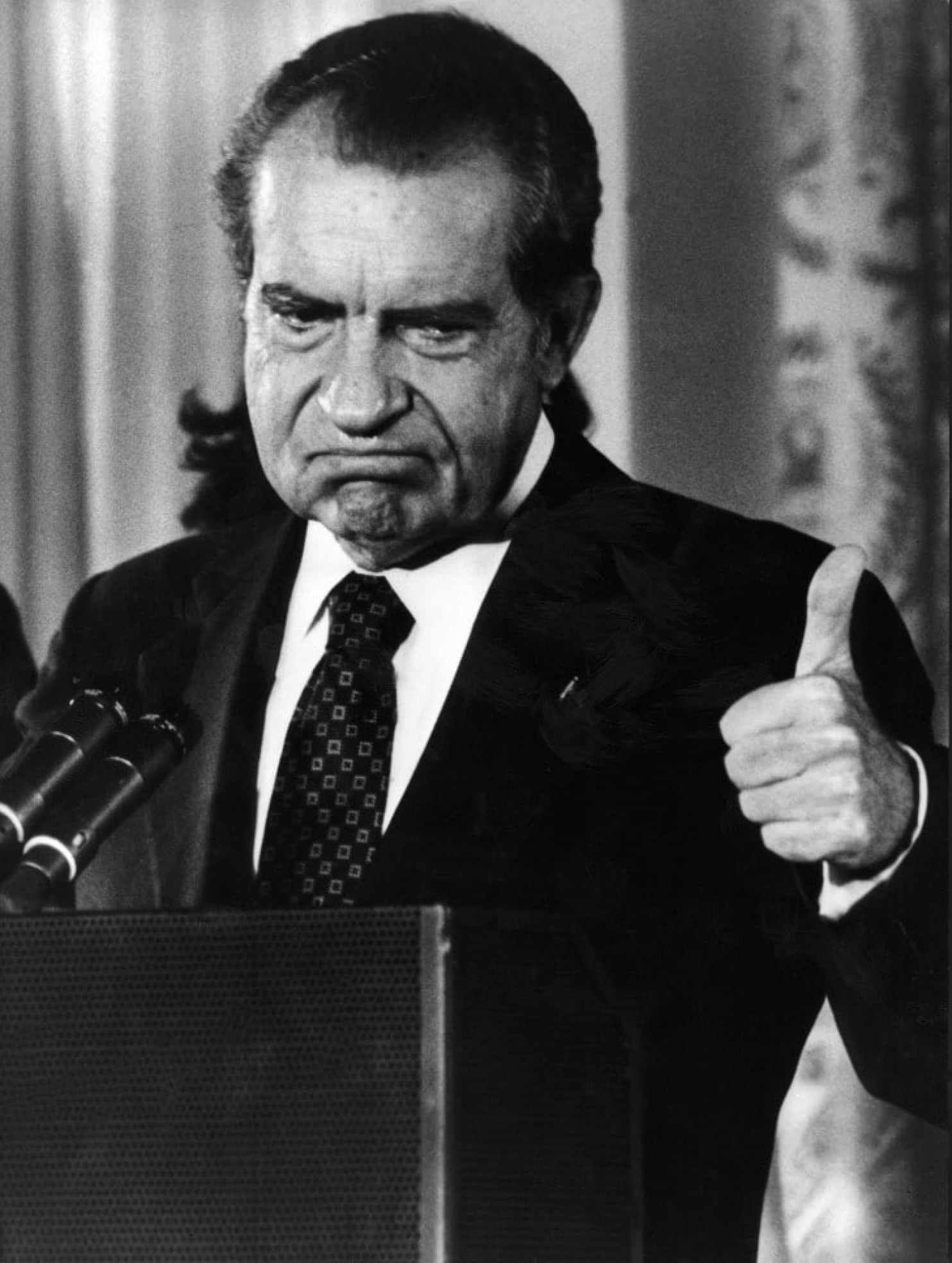
The “original sin” in this case was Gerald Ford’s preemptive pardon of Richard Nixon and the subsequent pardons of Caspar Weinberger by H.W. Bush and Marc Rich by President Clinton.
In each of these cases, the individuals were pardoned before they were convicted. And in Nixon’s case, even before the former president was indicted. These presumptive pardons are particularly harmful and do not conform to constitutional intent.
In its original conception, a pardon must both be granted and received, as in “I beg your pardon,” and is, therefore, an admission of guilt.
In other words, the recipient of a pardon is granted forgiveness and, thus, must be guilty of something. There is a presumption of innocence in the Constitution’s due process provisions; a person is presumed innocent until proven guilty. Therefore, a pardon cannot be granted to an innocent person, and a person who is not yet convicted is, by definition, innocent. Consequently, an innocent person cannot be granted a pardon.
Yes, the pardon is an unrestrained power, but the pardon cannot be used to subvert (only to supplement) the legal system.
Pardons of persons not yet convicted deny us, the American people, justice. We are denied the closure that comes with the exposure of crimes presented at trial. And, more nefariously, pardons can be used to cover up the president’s own participation in a crime. Iran Contra could be an example of this.
But how can we know if the participants were pardoned and prosecutors no longer have the leverage of a prosecution or jail sentence?
Framers’ Intent
Among others, Justice Amy Coney Barrett is a textualist.
I invite her and the other justices on the Supreme Court to review the Framers’ intent in incorporating the pardon provision into the Constitution.
The Framers did not intend to allow the pardon to be used as a blanket shield from prosecution of the president’s friends and associates. Note I use the word prosecution, the process of conviction. Once convicted, there is some logic in granting forgiveness after someone is found guilty.
Therefore, Trump can’t pardon himself. He is at present innocent. In some sense, he has hoisted himself by his own petard by insisting that he cannot be prosecuted while he serves in office. But as soon as he’s out, I hope that the Department of Justice indicts someone in the Trump orbit who has been preemptively pardoned. Then let’s have this thing out.
I am fairly confident that the case will establish a precedent that will better define, and on a good constitutional basis, delimit what has become an embarrassment in the exercise of presidential power.
Disclaimer: The views and opinions expressed here are those of the author and do not necessarily reflect the editorial position of The Globe Post.