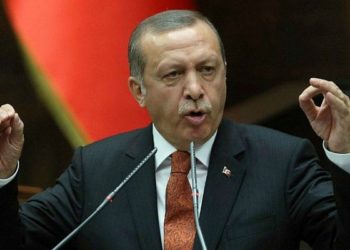



Turkey has literally become a party-state after President Recep Tayyip Erdogan returned to the party as its leader in a party congress on Sunday.
He added the title of party leadership to his staggering presidential status, solidifying his already omnipresent mark on every layer of the party with the new move, making a de facto situation a de jure reality.
He even did not wait for 2019 when the constitutional amendment approved by a popular vote last month takes effect, allowing the president also to retain party leadership.
In the presence of a loyal constituency of the ruling Justice and Development Party (AKP) during a congress in Ankara, President Erdogan introduced a massive overhaul in the party’s top cadres, parting ways with AKP bigwigs who had long shaped the party policies over the past decade.
A new, young and aspirant generation of politicians, avowedly loyal to the Chief — a nickname given to President Erdogan — will be in the frontlines and senior positions. The reshuffle speaks to the volume of Mr. Erdogan’s ever-tightening grip over the party, eliminates any would-be figure of substance and personality.
In a public display of not-too-subtle rift with incumbent President Erdogan, former President and one of the AKP’s four founding fathers Abdullah Gul declined invitation to attend the party congress. He had previously refused to endorse President Erdogan for constitutional change envisaging a stronger presidency in last month’s referendum.
Mr. Erdogan’s speech to a glowing, energetic party base contains elements clarifying on what awaits Turkey and the party in the near future. One of the fundamental themes of his address was when the state of emergency, a source of festering grievances and litany of complaints in the public, would end. The answer is disheartening.
The president was blunt and unreserved about the emergency rule, which was extended for another 3 months after the referendum last month. He said the state of emergency will remain in place as long as the government needs to maintain stability, defeat Kurdish and Islamist insurgents. He simply unveiled his intention that he would rule the country with that regime in an open-ended fashion, with no end in sight.
The announcement is the bearer of bad tidings given the widespread consensus among observers and critics alike that the emergency rule has been the chief cause of gross human rights violations and steady deterioration of democratic mechanisms. Already, nearly 150,000 public officials have been summarily discharged from their positions in civil service and the military without a due process.
There is no way for them to pursue a domestic legal remedy to address their complaints and demands as long as the emergency measures remain in place. The emergency rule enabled the government to govern the country with decrees, which have the full force of law, sidestepping any concern for individual liberties, media freedom, rule of law and fair trial for coup suspects.
The president stuck to his personal credo, offering a fire-breathing, rabble-rousing speech, vowing to fight Turkey’s enemies at home and abroad.
“Rather than facing our people with our heads down tomorrow, we prefer to stand tall today against the scum at home and abroad,” he told jubilant AKP supporters.
“The months ahead will be a leap forward for Turkey, from its fight against terrorism to the economy, from the broadening of rights and freedoms to investments,” Reuters quoted the president as saying.
It was not an uplifting speech. His address, true to his nature, dispelled the last vestiges of whatever hope remained for a reset in Mr. Erdogan’s rancorous relationship with his opponents. It was disheartening for complacent and expectant observers who, wrongly, eyed for a fresh start. Expectations for efforts by the president to smooth over rancor of the past months, slow down 10-month sweep of purge appeared to be misplaced.
President Erdogan is a master of political warfare, a ploughman of troubled waters whose hold on to power is defined by never-ending political wars, not by diplomacy or peace. For someone who mastered at war-making, seeking social or political peace amounts to a self-inflicted defeat or a suicide as long as he sees the war as the only way of preserving his power.
It was by nature, not by design, according to Mr. Erdogan’s core supporters and senior advisors, that war against political enemies is the only option for political survival. And Mr. Erdogan has been fighting since the day when a sprawling corruption investigation broke out three and half years ago, or since Gezi Protests during 2013 summer, or may be the day when he vaulted to the prime ministry 14 years ago.
On Sunday, the party-state unification has become a political reality. President Erdogan who left the party in August 2014 when he was elected as president now will be able to steer his party’s legislative works.
Mr. Erdogan who has already cast off conventions that constrained previous presidents over active involvement in partisan politics will now do it with great impunity. He blatantly disregarded the constitutional provision that keeps presidents above the political fray; chaired cabinet meetings at his presidential palace to set the government agenda and policy. And his return to party politics is taking place under a constitutional shield, though 2 years before its initial date when it goes into effect.
Last month’s controversial referendum was a watershed moment for Turkey’s modern political history given its repercussions for wide-ranging systemic change. It bestowed sweeping powers on the presidential office, altering the political balance of power at the expense of the legislative body. The referendum, according to critics, is bound to unwind century-old parliamentary system, elevates the executive branch to a level where there is little, if not totally absent, check on presidential powers.
Among the proposed changes, the head of the state will able to be the leader of a party, a factor that breaks down any boundaries between legislative and executive branches. Since 1950 and Ismet Inonu, second President of the Turkish Republic, Mr. Erdogan has become the first leader who is now both head of state and a party leader at the same time.
In addition to his already far-reaching powers, which include issuing decrees, appointing cabinet members, vice presidents, and dissolve Parliament, the president will also be able to steer his party’s legislative agenda from Sunday on.
With retaking the helm of AKP, Prime Minister Binali Yildirim will only head the government, relinquishing his party leadership to Mr. Erdogan, the man who found and gave its current shape to ruling AKP.
As Turkey struggles to navigate through turbulent waters in the face of the menace of extremist terrorism and multiple challenges, Turkey’s descent into one-man rule will likely complicate its capabilities to cope with the existent threats. For Turkey’s president, it is for this reason that the country needs a strong presidential system to weather enduring challenges.
Unstable and incoherent coalition governments of the past, he repeatedly argued, doomed Turkey into financial disaster, political turmoil and social disorder. But his detractors and discontents disagree. The new system will not heal Turkey’s woes and misgivings, as the post-coup emergency rule showed; too much centralization of power at one center only aggravated hardships, not resolved them.
********
This article was possible thanks to your donations. Please keep supporting us here.