

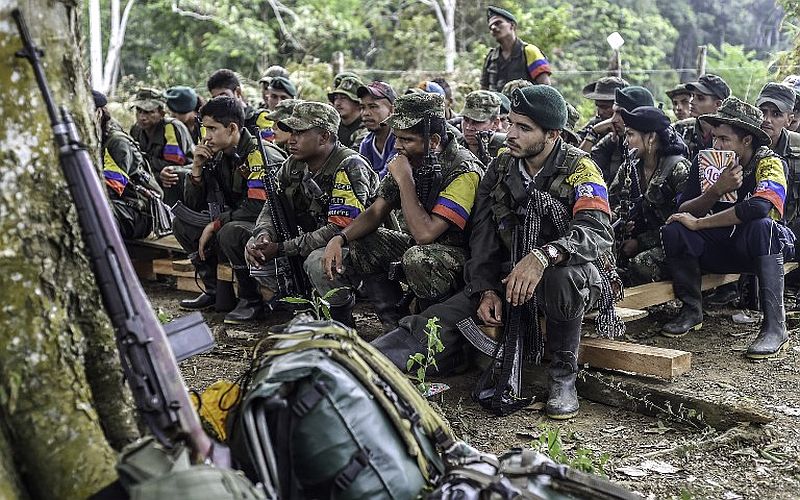
The story of Colombia’s 2016 peace deal with the FARC-EP (Revolutionary Armed Forces of Colombia – People’s Army) is a story of deep societal division. The parliamentary elections earlier this year have confirmed what the plebiscite on the deal had shown previously: Colombians are deeply divided on whether or not to endorse the agreement.
The conservative Centro Democratico party, led by former president Álvaro Uribe, is the big winner of the recent parliamentary elections. Uribe is the most vocal opponent of the peace agreement and currently under investigation for manipulating evidence and supporting right-wing paramilitaries. With conservative forces strengthened after the parliamentary elections in March 2018, the upcoming presidential elections on May 27 will set the future path for peace in Colombia.
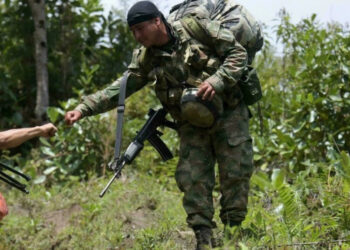
Flawed as it may be, the agreement managed to temporarily halt violent confrontations between the Colombian government and most factions of the largest guerrilla group in Latin America. Over the span of 50 years, 220,000 people had been killed, 25,000 disappeared and more than five million displaced. While ending hostilities is an important step, it can only be the beginning of a long and difficult path to sustainable peace in Colombia.
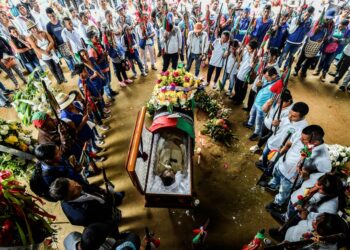
The situation is dire, with numerous violent actors seeking to fill the gap left behind by demobilized FARC fighters. And it has the potential to deteriorate further. Colombia has seen a surge in right-wing violence, with many left-wing activists and social leaders who advocated for political representation and economic reparations being threatened or killed. Colombia’s capital Bogotá saw bombings targeting protestors and police.
In order to successfully implement the agreement, a number of reforms are needed to tackle political, economic and societal issues. Only a third of about 30 laws needed to implement remaining parts of the deal had been passed by Congress by the end of 2017. If underlying problems that produce grievances and sustain divisions are not addressed, the conflict between the Colombian government and the FARC may soon turn violent again.
Questions of land distribution remain a key priority for the FARC, which originally developed in rural areas, demanding agrarian reform. To this end, the agreement created the Comprehensive Rural Reform Land Fund, which is supposed to distribute 3 million hectares of land over 12 years to rural people with or without the insufficient land.
However, implementation of this first point of the agreement has been virtually non-existent. The land that is to be redistributed is located in remote areas, lacks infrastructure and therefore prevents farmers from selling their crops. The deal also introduced more land titling, thus legalizing possession of land and making it purchasable, which will potentially further heat up the spiral of capital accumulation that has been an underlying cause of the conflict for decades.
This disregard for addressing socioeconomic inequalities is part of a larger pattern. Efforts to broker and implement peace agreements are often characterized by liberal governance, free market economics, and a focus on civil and political rights to the detriment of economic, social and cultural rights. In Colombia, this focus has alienated many former supporters of the agreement and strengthened those that favor a hard-handed approach against the FARC, no matter the consequences.
With key parts of the accord not implemented, its uncertain future should come as no surprise. In order to set it on the path to success again, a concentrated effort is needed to strengthen actors that call for full implementation of all agreed-upon measures. The patrons of the agreement who played an important role in brokering it, in particular Cuba, Norway, and Chile, should reassert pressure on the Colombian government to fulfill its obligations.
Cuba and Norway, countries that have played a key role in the negotiations, have good contacts with all sides of the conflict and have proven themselves to be reliable partners. They are thus in an advantageous position to restart a dialogue on full implementation, engage opposition leaders, and bring attention to the adverse consequences for peace in Colombia if the deal was to be abandoned. This refers not only to the conflict with FARC but also to other armed actors, in particular the ELN (Ejército de Liberación Nacional), with whom the government has been in talks since April 2017, so far with limited success.
The European Union, which so far supported the peace process through the E.U. Trust Fund for Colombia and the E.U. Instrument Contributing to Stability and Peace, should recalibrate its diplomatic and financial efforts to meet a more hostile political climate. This means engaging opposition leaders, highlighting the issue of violence against political and social leaders, and targeting financial support towards parts of the agreement that have not been implemented so far.
If peace in Colombia is to be sustainable, societal divisions have to be addressed. This will need sustained efforts to eradicate socioeconomic inequalities – efforts which were agreed upon in the Final Agreement. If the facilitators of the agreement and the European Union coordinate their attempts to advocate for full implementation of the deal, a return to violence might still be averted. A failure to implement the agreement would be a fatal signal for ongoing talks with other armed groups that continue to terrorize the people of Colombia.
Disclaimer: The views and opinions expressed here are those of the author and do not necessarily reflect the editorial position of The Globe Post.